The flag of Andorra is one of Europe's most symbolically rich national flags, representing a small but proud principality nestled in the Pyrenees mountains between France and Spain. From its bold tricolour stripes to a detailed coat of arms that carries centuries of political history, there's far more to this flag than first meets the eye.
What's in this Guide?
In this post, you'll find a thorough breakdown of the Andorran flag: its origins, what its colours represent, and the meaning behind each element of its coat of arms.
Jump to:
- A Brief Introduction to Andorra
- What Does the Andorran Flag Look Like?
- What is the History of the Andorran Flag?
- What Does the Andorran Flag Represent? The Colours Explained
- The Coat of Arms: A Closer Look
- What is the Cow on the Andorran Flag?
- The Motto: Virtus Unita Fortior
- How the Flag Compares to Its Neighbours
- Frequently Asked Questions
- Study Heraldry for £29
A Brief Introduction to Andorra
Andorra is one of Europe's smallest nations, covering just 468 square kilometres. Despite its size, it has a proud and independent history stretching back to the 9th century. For hundreds of years it was governed jointly by two co-princes: the Bishop of Urgell in Spain and the Count of Foix, whose rights later passed to the French head of state. This unusual political arrangement, known as a co-principality, is still in place today and it's directly reflected in the national flag.
What Does the Andorran Flag Look Like?
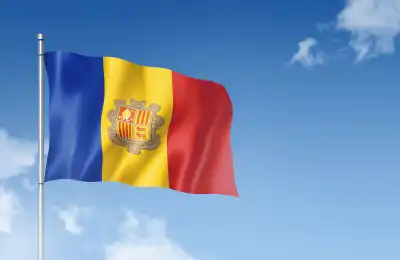
The flag of Andorra consists of three vertical stripes: blue on the left, yellow in the centre, and red on the right. In the middle of the yellow stripe sits the country's coat of arms, making it instantly distinguishable from similar tricolour flags used by other nations. The flag's proportions are typically rendered at a ratio of 7:10.
Without the coat of arms, the Andorran flag could be mistaken for the flags of Romania, Chad, or Moldova, all of which share the same blue, yellow, and red colour scheme. The coat of arms is what sets it apart and gives it its unmistakable national identity.
What is the History of the Andorran Flag?
The history of the Andorran flag is closely tied to the country's long-standing political structure. Andorra's origins as a recognised territory date to 1278, when the Treaty of Pareatge established the co-principality arrangement between the Bishop of Urgell and the Count of Foix. This treaty defined how Andorra would be governed, and the flag's design reflects those very same power structures.
The colours blue and red are traditionally associated with France, while blue and yellow are linked to the historical arms of the Bishop of Urgell. The combination of all three colours was intended to represent both ruling entities united under one banner.
The modern version of the flag was officially established in 1866, though variations of the tricolour had been in use for some time before that. The coat of arms at the centre was incorporated to distinguish the flag from similar designs and to convey the complexity of Andorra's unique governance. Over the centuries, minor adjustments have been made to the exact design of the coat of arms, but the essential tricolour format has remained consistent.
It's worth noting that Andorra's civil and state versions of the flag differed slightly depending on context. The state flag always included the coat of arms, while some earlier civil uses omitted it. Today, the version with the coat of arms is the widely recognised standard.
What Does the Andorran Flag Represent? The Colours Explained

So, what does the Andorran flag represent in terms of its colour choices? Each stripe carries historical and political significance:
- Blue symbolises Andorra's relationship with France, particularly the Count of Foix, whose rights eventually passed to the French state. Blue also appears in the French tricolour.
- Yellow represents the historic county and is associated with the ecclesiastical authority of the Bishop of Urgell.
- Red appears in both the French and Spanish flags, reflecting Andorra's geographic and political ties to both nations.
Together, the three stripes are a visual reminder that Andorra has always existed at the intersection of two powerful neighbours, shaped by both yet fully belonging to neither. There's a quiet dignity to the flag: it doesn't shout its allegiances, but it quietly acknowledges them.
The Coat of Arms: A Closer Look
The coat of arms sits at the very heart of the flag, and it's where most of the symbolic weight lies. It's divided into four quadrants, each representing one of the four historical lords associated with Andorra's governance. Understanding these four sections is key to understanding what makes the Andorran flag so historically layered.
The Bishop of Urgell
The top-left quadrant shows a bishop's mitre and crozier on a red background, representing the ecclesiastical co-prince who has held joint sovereignty over Andorra since the 13th century. The mitre is the distinctive liturgical cap worn by bishops, and the crozier is the ceremonial staff associated with church authority.
The Count of Foix
The top-right quadrant displays three red vertical stripes on a golden background. These are the traditional arms of the County of Foix, the French noble house that was one of Andorra's original co-princes. When the County of Foix was absorbed into the French crown, those rights passed first to the King of France and later to the French Republic, meaning today's co-prince on the French side is the President of France.
The Viscount of Béarn
The bottom-left quadrant features two cows on a red background, the quarter most people find immediately striking and arguably the most discussed element of the entire coat of arms. These cows represent the historic Viscountcy of Béarn, a territory in what is now south-western France. The Viscounts of Béarn were key allies and feudal overlords of the counts of Foix, and their heraldic symbol has been carried into the Andorran coat of arms as a mark of that historical relationship.
The Catalan Counts of Urgell
The bottom-right quadrant shows four red vertical stripes on a golden background, the classic arms of the Catalonian royal family and specifically the Counts of Urgell, who were historical lords of parts of Andorra. You'll recognise this design if you're familiar with the Catalan flag, which features similar vertical stripes.
What is the Cow on the Andorran Flag?

The cows on the Andorran flag are among the most commonly asked about aspects of its design. Many people encounter the flag and immediately wonder why there are cows on a national symbol. The answer lies in feudal history.
The two golden cows on a red background in the lower-left quadrant of the coat of arms are the heraldic symbol of the historic Viscountcy of Béarn. Cattle were enormously important to the agricultural and economic life of the Pyrenean region, and it was common for noble families to incorporate local resources or livestock into their heraldic arms as a mark of the land and its people.
The use of the cow in heraldry isn't unique to Andorra. Bovine imagery appears in the coats of arms of several other European regions with strong pastoral traditions. The Andorran flag's cows are particularly notable, though, because they've persisted in the national symbol right through to the present day, serving as a striking reminder of the country's medieval roots and the enduring strength of symbols rooted in everyday life.
It's also a charming reflection of Andorra's identity. Despite being a modern, prosperous microstate, its flag still carries the marks of an agrarian Pyrenean culture that shaped the region for centuries. The study of heraldry offers a fascinating window into how families, regions, and nations encoded their histories into visual language in exactly this way. You can explore similar heraldic storytelling in our post on the Flag of Algeria.
The Motto: Virtus Unita Fortior
Below the coat of arms, a scroll bears the Latin motto Virtus Unita Fortior, which translates as "United virtue is stronger." It's a fitting motto for a nation that has survived and thrived for centuries by maintaining balance between two powerful neighbours, relying on diplomacy and cooperation rather than military might.
The motto also speaks to the way the four historical quarters of the coat of arms come together as a unified whole. It's not just decorative Latin; it's a statement of philosophy that has guided Andorra's diplomatic identity throughout its long history.
How the Flag Compares to Its Neighbours
It's worth placing the Andorran flag in the context of its nearest neighbours to appreciate how much its design borrows from and responds to both:
- France uses a vertical tricolour of blue, white, and red, sharing two of Andorra's colours.
- Spain uses a horizontal design of red, yellow, and red with a coat of arms at the centre, sharing the yellow and red of the Andorran flag as well as the concept of a central coat of arms.
The Andorran flag sits neatly between the two, drawing visually from both without copying either. It's the perfect symbol for a country that has always existed diplomatically between two larger powers, maintaining its own sovereignty while acknowledging its neighbours.
This kind of visual diplomacy is at the heart of heraldic tradition. Just as the eagle has long been used across European heraldry as a symbol of authority, national flags often carry layers of meaning that reward closer reading. The animals, colours, and arrangements chosen by ruling dynasties form part of a visual language connected to the broader tradition of sacred geometry and symbolic design that you can learn to decode.
Recommended for you!
Best Sellers





Frequently Asked Questions
Is the Andorran flag the same as any other country's flag?
Without its coat of arms, the Andorran tricolour of blue, yellow, and red is visually similar to the flags of Romania, Chad, and Moldova. The coat of arms in the centre is what makes the Andorran flag unique and distinguishes it from those designs.
Who designed the flag of Andorra?
There's no single designer on record. The flag evolved from the heraldic traditions of Andorra's co-ruling powers, with the modern version formally established in 1866 based on the country's long-standing political and heraldic history.
Has the flag of Andorra ever changed?
The core tricolour has remained consistent, though the exact rendering of the coat of arms has been refined over time. The main historical variation was between the state flag, which included the coat of arms, and an earlier civil version that sometimes omitted it.
Study Heraldry for £29
If reading about the flag of Andorra has sparked a curiosity in heraldry and the stories embedded in national symbols, the Heraldry Diploma Course at Centre of Excellence is a great place to go next. This online course covers the history and language of coats of arms, flags, and heraldic symbols in an accessible, self-paced format suitable for complete beginners and enthusiasts alike. Enrol for just £29!