Sword symbolism is a fascinating topic, whether you're interested in mythology, history, spirituality, or simply curious about why this weapon has held such a powerful place in human imagination.
Below, you'll find an exploration of sword history, the spiritual and mythological meanings of swords, and some of the legendary swords that continue to capture the world’s attention.
Jump to:
What Is a Sword?
A sword is a long-bladed weapon designed for cutting, thrusting, or both. The definition of a sword could be described as a handheld weapon formed of a sword blade (usually metal) attached to a hilt or handle.
Swords have always meant much more than their physical form. In many cultures, they were symbols of status, bravery, wisdom, and leadership; even today, they appear in spiritual teachings as representations of clarity, justice, and truth.
Who Invented the Sword?
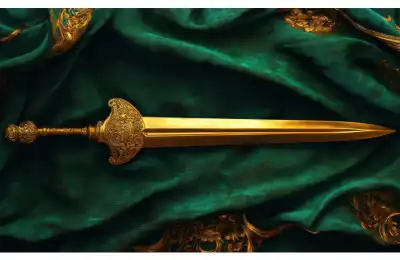
The person who invented the sword isn’t completely known, because early swords evolved gradually from bronze blades used thousands of years ago. What we do know is that the first recognisable swords appeared during the Bronze Age, when metalworking allowed people to create longer, durable blades. These early swords were relatively short, but they paved the way for iron and steel swords, which became stronger and more effective.
Throughout sword history, different cultures developed styles suited to their needs. For example:
- Ancient Egyptians used khopesh-style curved blades.
- The Romans developed the gladius, a short stabbing sword used in tight formations.
- Medieval Europe embraced the longsword and broadsword.
- Japan refined the katana, known for its sharpness and craftsmanship.
- Norse warriors used what many today simply call the Viking sword, a broad, double-edged weapon designed for strength and durability.
The sword is no longer a practical everyday weapon, but it remains deeply symbolic and historically fascinating.
What Does a Sword Symbolise?
Swords appear in almost every culture’s stories and mythology. Here are the most common interpretations of sword symbolism and what a sword represents:
- Courage and Strength: As a weapon once carried into battle, the sword naturally came to represent bravery. It symbolised the willingness to defend one’s people, honour, and beliefs.
- Justice and Truth: In many traditions, a sword represents truth cutting through illusion. Statues of Justice often hold a sword to show fairness and clarity.
- Authority and Leadership: Kings, knights, warriors, and heroes were often given swords during ceremonies to show that they had earned a position of power.
- Purification and Transformation: In myths and spiritual teachings, swords sometimes symbolise the ability to “cut away” what no longer serves you, helping you step into a new phase of life.
- Wisdom and Justice: Spiritually, the sword often represents higher wisdom, divine justice, and the ability to overcome darkness or ignorance.
What Do Swords Represent in Mythology?
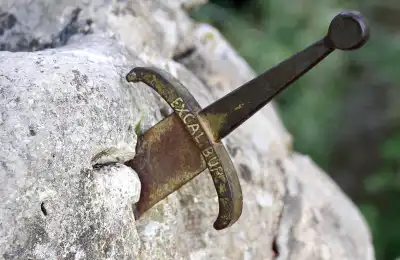
Mythology is filled with enchanted or divine swords. In these stories, the sword is rarely just a tool; instead, it’s a test, a symbol, or a sign of chosen destiny. Here are some common mythological themes:
- Hero’s worthiness: The hero must prove themselves to wield the sword.
- Divine origin: Many legendary blades are gifts from gods or spirits.
- Moral lessons: The sword often punishes arrogance or rewards humility.
- Transformation: The sword leads the hero to personal and spiritual growth.
Legendary Swords of Myth and Spirituality
Mythology across the world contains an astonishing number of legendary sword names. Below are some of the most famous and symbolically rich examples, each representing a different cultural tradition.
Excalibur (Arthurian Legend)
Perhaps the most iconic sword in history, Excalibur is King Arthur’s legendary blade. In most versions of the myth, Excalibur is not the Sword in the Stone; instead, it is given to Arthur by the mystical Lady of the Lake. The sword represents rightful rulership and divine selection.
Durandal (French Legend)
Said to be carried by Roland, a hero of French medieval literature, Durandal was unbreakable and symbolised steadfast loyalty. The sword is often described as containing sacred relics, which heightened its status as a divine and protective weapon.
Kusanagi-no-Tsurugi (Japan)
Part of the five heavenly swords in Japanese mythology, this sword symbolises courage, divine protection, and authority. It plays a key role in the story of the storm god Susanoo, who discovered it inside the body of a defeated serpent.
The Flaming Sword (Christian Mythology)
In Christian mythology, archangels such as Michael and Uriel are often depicted with swords of light or fire. Michael’s sword is associated with protection and justice, while Uriel’s sword is sometimes described as a flame or a blade of truth. These swords often represent divine power cutting through darkness, illusion, and spiritual threat.
Azrael’s Sword
Azrael, the angel of death, is occasionally described as carrying a spiritual or symbolic sword associated with the soul’s transition. It is not always given a specific name, but it represents the boundary between life and death.
Lucifer’s Sword
In Christian theology, Lucifer is often interpreted as a high-ranking angel who rebelled against God and was cast out of Heaven. In many depictions, Lucifer’s sword is more symbolic than literal, representing rebellion or fallen power. Different stories give different names, as it doesn’t belong to a single fixed tradition.
The Holiest Sword
Many traditions refer to sacred swords, but the holiest sword depends on the belief system. Some view Michael’s sword as holy, while others consider the flaming sword of Eden or Kusanagi to hold sacred status.
Cool Swords in History

If you're wondering about the best swords in history, here are some culturally significant examples known for craftsmanship and symbolic power:
- The Katana (Japan): A legendary example of engineering and artistry, known for its sharpness and the skill required to forge it.
- The Viking Sword (Norse Lands): A powerful double-edged weapon carried by Norse warriors. Its shape influenced many European swords.
- The Gladius (Rome): One of the most influential weapons in military history. Simple, effective, and symbolic of Roman discipline.
- The Longsword (Medieval Europe): Flexible in battle, used in duels, battlefield combat, and knight training.
What Are Swords a Symbol Of Today?
Although swords are no longer used in everyday life, they still appear in films, ceremonies, literature, and spiritual teachings. Today, swords often symbolise:
- Mental clarity
- Self-discipline
- The ability to cut away negativity
- Justice
- Heroic values
- Personal truth
Common Religious and Spiritual Questions About Swords
What Are the Four Holy Swords?
This depends on the tradition, but in some symbolic frameworks, the four holy swords refer to blades associated with virtues like justice, courage, wisdom, and purity.
What Are the Twelve Swords?
Again, this varies by tradition. Some fantasy texts and modern myths refer to a collection of twelve divine or magically significant swords, each with its own symbolic power.
What sword kills demons?
In folklore, holy or blessed swords, such as Michael’s sword or other divine blades, are said to defeat demonic forces. In fiction, the idea appears in many modern stories.
What sword does Jesus want us to use?
In Christian teachings, the sword is often metaphorical. The sword of the Spirit refers to truth and faith rather than a physical weapon.
What saint carries a sword?
Saint Michael is the most well-known, but several saints are depicted with swords as symbols of protection or martyrdom.
What Are The Five Heavenly Swords?
In Japanese mythology, this phrase usually refers to five divine swords linked to creation, chaos, sacrifice, and authority.
What Are The Four Swords of Power?
Some modern interpretations refer to magical or symbolic swords representing the classical elements—earth, air, fire, and water—or four virtues.
Recommended for you!
Best Sellers





Study Heraldry for £29
If you’d like to continue exploring the rich language of symbols, especially those linked to lineage, honour, clans, and tradition, our Heraldry Diploma Course is the perfect next step. It offers a fascinating look at coats of arms, crests, and the meanings behind heraldic imagery, ideal for anyone curious about symbolic design. Follow the link to access the course at the discounted price of £29!