The flag of Austria is one of Europe's most ancient national symbols, and if you're curious about its history, design, or the stories behind it, there’s a lot to unpack.
What's in this Guide?
This guide explores everything you need to know about the Austrian flag, from its legendary medieval origins and the meaning of its colours to the eagle emblem, the old imperial designs, and some surprising facts you might not have come across before.
Jump to:
- What Does the Austrian Flag Look Like?
- What is the Story Behind the Austrian Flag?
- Is the Austrian Flag One of the Oldest in the World?
- The Austrian Flag with Eagle: The Coat of Arms Version
- Why Are There Two Austrian Flags?
- Why Was the Austrian Flag Black and Yellow?
- The Austrian Empire Flags Through History
- Why Does the Austrian Flag Have a Hammer and Sickle?
- What is the Real Austrian Flag?
- Fun Facts About the Austrian Flag
- Study Heraldry for £29
What Does the Austrian Flag Look Like?
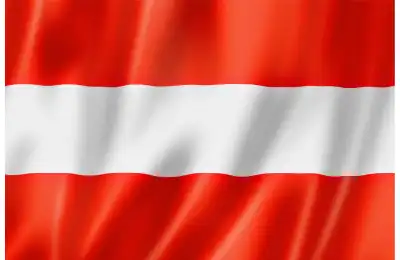
If you're wondering what the Austrian flag looks like, the design is refreshingly simple. The national flag of Austria, known in German as the Bundesflagge, consists of three horizontal bands of equal width. The top and bottom stripes are red, and the middle stripe is white. There’s no additional emblem, pattern, or text; just a clean, bold arrangement of two colours.
The red used is a deep, vivid crimson, and the contrast between it and the white centre makes the flag immediately striking. If you look at a picture of the Austrian flag, you'll quickly see why this design has endured for so long. There's an elegance to its simplicity that many more elaborate flags simply can't match.
That said, there's also a second version of the Austrian flag, one that incorporates a coat of arms, and understanding both versions is key to understanding what flag Austria uses today.
What is the Story Behind the Austrian Flag?
The story behind the Austrian flag is one of the most compelling origin tales in vexillology, which is the study of flags and their history. According to a long-held legend, the design dates back to the year 1191 and the Battle of Ptolemais (also known as the Siege of Acre) during the Third Crusade.
A Legend Born in Battle
Duke Leopold V of Austria reportedly fought with such intensity that his white surcoat became entirely soaked in blood during the battle. When he removed his sword belt afterwards, the strip of white fabric hidden beneath it remained clean and unstained, leaving a vivid image: a band of white sandwiched between two fields of red. So struck was he by this sight that he adopted the red-white-red design as his heraldic emblem.
As with many medieval legends, historians debate how much of this is historical fact and how much is romanticised storytelling. What's beyond doubt, however, is that the red-white-red design does appear in documented heraldic records from the early 13th century, making it one of the oldest continuously used flag designs anywhere in the world. Legend or not, the story perfectly captures the values the flag has come to represent: courage, sacrifice, and a fierce sense of national pride.
Is the Austrian Flag One of the Oldest in the World?
The flag of Austria is widely considered one of the oldest national flags still in use today. The red-white-red colours are first documented in a historical record from 1230, giving the design a verified history of nearly 800 years.
For context, the only flag with a comparable or arguably older continuously documented history is the Danish flag, the Dannebrog, which dates back to a similar period. Most national flags as we know them today were designed in the 18th, 19th, or 20th centuries, making Austria's ancient tricolour a genuine rarity.
When you see the Austrian flag flying above a government building or unfurling at an international event, you're looking at a design that has outlasted dynasties, revolutions, and two world wars.
The Austrian Flag with Eagle: The Coat of Arms Version
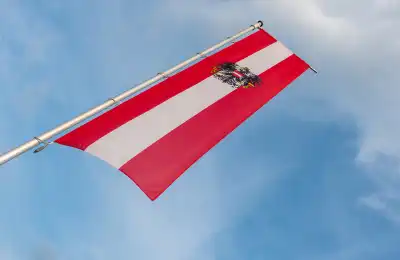
Alongside the simple red-white-red tricolour, there's an official state version of the flag that features Austria's famous coat of arms at its centre. This is the Austrian flag with the eagle, used by the federal government, official state bodies, and Austrian embassies and consulates around the world.
What is the Austrian Eagle?
The Austrian eagle, known formally as the Bundesadler or "federal eagle", is a black eagle with its wings spread wide. It's a powerful and carefully designed Austrian symbol, rich in meaning:
- The eagle holds a hammer in its right talon, representing the working class and industrial labour.
- In its left talon, it holds a sickle, representing the agricultural sector and farming communities.
- On its head sits a mural crown, symbolising Austria's towns and cities.
- A broken chain hangs from its talons, representing liberation from oppression and fascism following the Second World War.
- On the eagle's breast, the red-white-red shield echoes the colours of the national flag itself.
The Austrian eagle draws on centuries of heraldic tradition. Eagles have featured in Austrian heraldry since at least the medieval period, used as symbols of strength and sovereignty. The current version of the eagle was formally adopted after 1945 and reflects the values of modern, democratic Austria.
Why Are There Two Austrian Flags?
The existence of two versions of the Austrian flag, one plain and one with an eagle, is a common source of confusion. The distinction is actually quite logical once you understand it.
- The plain red-white-red tricolour is the civil flag. It's used by private citizens, businesses, sports teams, and in everyday public life.
- The flag with the coat of arms is the state flag. It's used by government institutions, official state functions, and embassies abroad.
This two-flag system is common in many countries. Germany, for example, also has separate civil and state flags. In Austria's case, the simpler version is what most people around the world recognise, while the eagle version carries the formal authority of the Austrian republic. Both are entirely legitimate representations of the nation; they simply serve different purposes.
Why Was the Austrian Flag Black and Yellow?
If you've come across references to an old Austrian flag in black and yellow, you might be wondering how that fits with the red and white design we know today. The answer lies in the history of the Habsburg dynasty.
The Old Austria Flag Under the Habsburgs
The Habsburgs were the ruling imperial family of Austria for centuries, and their imperial colours were black and gold (or yellow). These colours became deeply associated with Austrian imperial power, particularly during the 18th and 19th centuries. The old Austrian flag and imagery of this era, from uniforms and banners to official seals, were dominated by black and yellow rather than red and white.
When the Austro-Hungarian Empire collapsed at the end of the First World War in 1918 and Austria became a republic, the new government made a deliberate choice. Rather than retaining the imperial black and yellow, they reached back further into history and restored the medieval red-white-red design. It was a powerful statement: Austria wasn't just reinventing itself, it was reconnecting with its oldest heraldic identity.
The Austrian Empire Flags Through History
Austria's flag history is a vivid reflection of the country's turbulent and layered past. Here's a brief overview of how things evolved over the centuries:
- 13th century: The red-white-red design is first recorded, associated with the Babenberg dynasty and the legend of Duke Leopold V.
- Habsburg era: The black and yellow imperial colours become dominant as the Habsburgs build one of Europe's most powerful empires.
- 19th century: During periods of revolution and unrest, various Austrian Empire flags emerged, sometimes incorporating pan-German black, red, and gold.
- 1918: With the collapse of the Austro-Hungarian Empire, the Republic of Austria formally readopts the red-white-red tricolour.
- 1938 to 1945: Austria is annexed by Nazi Germany during the Anschluss. The Austrian flag is suppressed and replaced with the German flag.
- 1945 onwards: Following liberation, the red-white-red flag is restored. The updated coat of arms, including the broken chain, is added to reflect Austria's post-war values.
Each of these shifts tells you something important about how Austria understood itself at that moment in history, and how national symbols can evolve without losing their core identity.
Why Does the Austrian Flag Have a Hammer and Sickle?
On seeing the Austrian state flag's coat of arms, with its hammer and sickle held in the eagle's talons, it's natural to wonder whether this has any connection to Soviet communism.
The short answer is: no. In the context of Austria's coat of arms, the hammer represents the working class and industrial labour, while the sickle represents farming and agricultural communities. Together, they're a symbol of national unity, a recognition that Austria's strength comes from all of its people, across all walks of life.
Is the Hammer and Sickle Symbol Offensive?
The hammer and sickle is most widely associated with Soviet ideology, which is why it can provoke strong reactions when seen out of context. In Austria's national emblem, however, the symbols predate their Soviet associations and carry an entirely distinct meaning rooted in European heraldic tradition.
Whether the hammer and sickle symbol is considered offensive depends entirely on context, and this is precisely why understanding the history and purpose behind any symbol matters so much. The same image can mean radically different things in different cultural and historical settings. Heraldry is the study of exactly this kind of layered meaning.
What is the Real Austrian Flag?
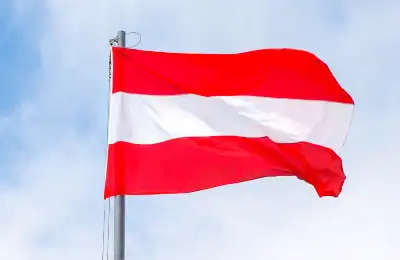
Given all the variations, the plain tricolour, the eagle version, and the old imperial black and yellow, it's reasonable to ask what the real Austrian flag actually is.
Legally and officially, the real Austrian flag is the red-white-red tricolour. This design is enshrined in Austrian law and is the flag recognised internationally as representing the Republic of Austria. The version with the coat of arms is an official variant used in specific state contexts, and it too is a legitimate representation of the country.
The black and yellow colours belong to the Habsburg imperial legacy, a significant part of Austrian history, but not the identity of modern Austria as a democratic republic. If you want to identify the flag of Austria at a glance in any international setting, the three horizontal stripes of red, white, and red are what to look for.
Fun Facts About the Austrian Flag
To finish things off, here are some of the most surprising and delightful facts about the Austrian flag:
- The red-white-red design is documented as far back as 1230, making it one of the oldest national flag designs still in use anywhere on Earth.
- Austria's flag is strikingly similar to Latvia's flag; both use red-white-red horizontal stripes, though Latvia's shade of red is noticeably darker and more muted.
- The broken chain on the coat of arms eagle was deliberately added in 1945 to symbolise Austria's liberation from Nazi annexation and fascism.
- The mural crown on the eagle's head, representing Austria's towns and cities, replaced an earlier imperial crown as a symbol of the country's shift from monarchy to republic.
- Austrian embassies worldwide display the state flag with the eagle, meaning this version is often the most internationally visible, even though the plain tricolour is the civil standard.
- The legend of Duke Leopold V and his blood-stained surcoat, first recorded in the 13th century, remains one of the most enduring origin stories in the history of European heraldry.
- During the Anschluss from 1938 to 1945, the Austrian flag was banned. Its restoration in 1945 was a deeply symbolic act of national renewal.
Recommended for you!
Best Sellers






Study Heraldry for £29
If exploring the stories behind flags, eagles, and coats of arms has sparked something in you, why not take that curiosity further? The Heraldry Diploma Course at Centre of Excellence offers a rich and engaging journey into the history, language, and symbolism of heraldry, from medieval shields and dynastic emblems to national symbols like the Austrian eagle. Enrol today for just £29!