The flag of Antigua and Barbuda is one of many national flags around the world that packs genuine symbolism into a bold design, combining a rising sun with a striking V-shape. If you've ever wondered what the colours and shapes on this flag actually represent, this guide covers its full history and meaning.
What's in this Guide?
This guide explains the history of the Antigua and Barbuda flag, what its colours and sun represent, and the meaning behind its distinctive V-shape. You'll also find some quick facts about the flag's design and adoption.
Jump to:
The History of the Antigua and Barbuda Flag
The current flag of Antigua and Barbuda was adopted on 27 February 1967, marking the islands' transition to self-governing status in association with the United Kingdom. Before this, Antigua and Barbuda flew a Blue Ensign defaced with a colonial coat of arms, in keeping with the design used across other British territories at the time.
The flag was chosen through a national design competition that drew more than 600 entries. The winning design came from Sir Reginald Samuel, an Antiguan artist, sculptor, and art teacher, who reportedly created the design in around half an hour before rushing to submit it just before the deadline. When Antigua and Barbuda achieved full independence on 1 November 1981, the flag remained unchanged, continuing to represent the nation to this day.
What Do the Colours on the Flag Mean?
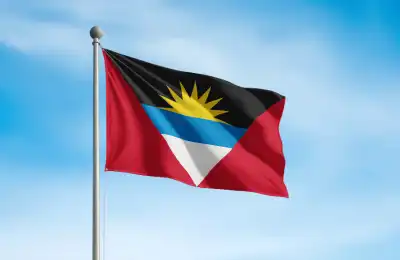
Each colour on the flag carries its own distinct meaning:
- Red represents the energy and dynamism of the Antiguan and Barbudan people, as well as the resilience of their ancestors.
- Black represents the African heritage of the majority population, along with the islands' fertile soil.
- Blue represents hope, along with the surrounding Caribbean Sea.
- White represents the islands' sandy beaches, a nod to Antigua and Barbuda's importance as a tourist destination.
Together, the black, blue, and white bands are sometimes read as representing the sun, sea, and sand that define the islands' landscape.
What Does the Sun Represent?
The golden rising sun at the centre of the flag symbolises the dawn of a new era, marking the country's move away from colonial rule towards self-governance. The sun's seven points have since come to be associated with the six parishes of Antigua plus the island of Barbuda, though this specific interpretation was added later rather than being part of Sir Reginald Samuel's original design.
What Does the V Shape Mean?
The V-shaped design formed by the flag's inverted triangle is widely interpreted as a symbol of victory, reflecting the phrase "victory at last" in reference to the islands' journey towards self-governance. The shape is also sometimes read as resembling the letter "A," a subtle nod to Antigua itself.
Flag of Antigua and Barbuda: Colours, Codes & Dimensions
If you're looking to reproduce or print the flag accurately, it's worth knowing that no single official government specification for exact shades has ever been published, so slightly different reference values appear across various sources. That said, the following are the most commonly cited specifications:
- Ratio: 2:3 (width to length)
- Red: Pantone 186C, approximately #CE1126
- Blue: Pantone 300C, approximately #0072C6
- Yellow/Gold: Pantone 116C, approximately #FCD116
- Black: #000000
- White: #FFFFFF
Because these values vary slightly depending on the source, it's worth double-checking with a specialist flag manufacturer if you need an exact match for official or ceremonial use.
Antigua and Barbuda Flag Etiquette
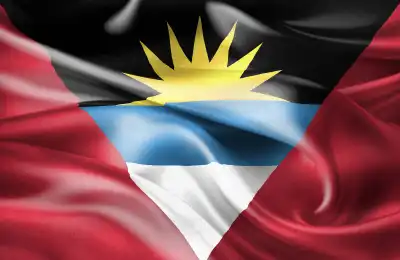
Like most national flags, the Antigua and Barbuda flag is subject to certain customs around when and how it's displayed. It's flown at full mast on national occasions such as Independence Day on 1 November and National Heroes Day on 9 December, and lowered to half-mast during periods of official mourning, such as the death of a head of state or senior national figure.
As with most national flags, it's generally considered proper etiquette to avoid letting the flag touch the ground, to retire a damaged or faded flag respectfully rather than continuing to fly it, and to display it the right way up, with the sun and triangle pointing towards the flagpole.
Fast Facts About the Flag
- Adopted: 27 February 1967
- Designer: Sir Reginald Samuel
- Design: A red field with an inverted isosceles triangle containing horizontal bands of black, blue, and white, topped with a seven-pointed golden sun
- Unchanged since independence: The design has remained the same since Antigua and Barbuda gained full independence on 1 November 1981
Frequently Asked Questions
When Was the Antigua and Barbuda Flag Adopted?
The flag was adopted on 27 February 1967, when the islands achieved self-governing status in association with the United Kingdom.
Who Designed the Antigua and Barbuda Flag?
The flag was designed by Sir Reginald Samuel, an Antiguan artist and art teacher, who won a national design competition with over 600 entries.
Did the Flag Change When Antigua and Barbuda Became Independent?
No, the same flag design has been used continuously since 1967, including after the country achieved full independence from the United Kingdom on 1 November 1981.
What Do the Seven Points on the Sun Represent?
The seven points are commonly said to represent the six parishes of Antigua and the island of Barbuda, though this interpretation was added after the flag's original design rather than being part of the designer's original intention.
Is There a Difference Between the Antigua and Barbuda Flag and Its Coat of Arms?
Yes. While the flag uses simple colours and shapes to represent the islands' identity and history, the coat of arms is more detailed, featuring symbols like a pineapple and sugar mill that reflect the islands' agricultural heritage, part of the wider study of heraldry as a symbolic tradition.
Is the Antigua and Barbuda Flag Used as a Civil Ensign?
Yes, the national flag also serves as the country's civil ensign, while a separate state ensign featuring a white field and red cross is reserved for use by the national coast guard.
Recommended for you!
Best Sellers


Study Heraldry for £29
If flags and their symbolism have sparked your curiosity, our Heraldry Diploma Course explores the history and meaning behind national and family symbols in far more depth. For a limited time, you can enrol for just £29.