If you've ever looked at the flag of Australia and wondered what it symbolises, this guide is for you. We’ll walk you through everything you need to know about the Australian flag, from its origins and design to the meaning of its stars, colours, and ongoing debates. You'll come away with a clearer picture of what this iconic symbol really represents.
Jump to:
- What Does the Australian Flag Look Like?
- Australian National Flag History
- What Does the Australian Flag Represent?
- How Many Stars Are on the Australian Flag?
- Australian Flag Colours
- Australian Flag Facts
- Why Does Australia Fly Three Flags?
- The Debate Over a New Flag
- Which Country Has a Similar Flag?
- Flag Rules and Etiquette
- Study Heraldry for £29
What Does the Australian Flag Look Like?
The flag of Australia features a deep blue background, officially known as the Blue Ensign, divided into three distinct sections.
In the upper left corner sits the Union Jack — the flag of the United Kingdom — representing Australia's historical connection to Britain. Below it is a large, seven-pointed star known as the Commonwealth Star or Federation Star. On the right-hand side is the Southern Cross: a cluster of five white stars arranged to reflect the constellation as it appears in the Southern Hemisphere skies.
Together, these three elements tell the story of where Australia came from, where it sits on the planet, and what it has grown into as a nation. Every part of the Australian national flag has been carefully considered, and each carries meaning that continues to resonate today.
Australian National Flag History

How Old Is the Australian Flag?
The Australian national flag is older than many people realise. It was first flown on 3 September 1901, just months after Australia became a federation on 1 January of that year. To mark this milestone, a public competition was held to design the country's flag, and it attracted over 32,000 entries from across the nation. Five people independently submitted near-identical winning designs and shared the £200 prize between them.
The flag was given its legal standing under the Flags Act 1953, which formally established it as the national flag of Australia and set out the precise specifications for its design. So while the flag's origins stretch back to 1901, it's been legally codified for just over seventy years, making it a relatively modern fixture in terms of official recognition, even if the design itself predates that.
Did Australia Ever Have a Different Flag?
For much of the early twentieth century, two versions of the Australian flag were in common use. The Blue Ensign was traditionally reserved for government and official use. Alongside it was the Red Ensign, which carried the same design but on a red background. The Red Ensign was used by merchant vessels and, for a time, by ordinary civilians.
Over the decades, the Blue Ensign gradually became the flag that all Australians identified with, and it's now the universally recognised Australian national flag. The Red Ensign still technically exists as a civil ensign for merchant shipping, but it's rarely seen in everyday life.
What Does the Australian Flag Represent?
The meaning of the flag of Australia is layered. Each of its three main elements carries its own symbolism, and understanding them together gives a far richer picture of what the flag stands for.
The Union Jack
The Union Jack occupies the canton (the upper left quarter) of the flag. Its presence reflects Australia's origins as a collection of British colonies, established from 1788 onwards. For much of its early history, Australia's legal, cultural, and political life was deeply tied to Britain. Even after federation, those connections remained strong, and the Union Jack on the flag was a natural expression of that bond.
Today, its inclusion is both celebrated and questioned, depending on who you ask. For some, it's an honest representation of history. For others, it feels like a symbol that no longer reflects modern Australia. That debate continues, and it speaks to a broader conversation about national identity that the country is still working through.
The Commonwealth Star
Directly beneath the Union Jack sits the Commonwealth Star, one of the most distinctive features of the Australian national flag. This large, seven-pointed star has six points representing the six states of Australia: New South Wales, Victoria, Queensland, South Australia, Western Australia, and Tasmania. The seventh point, added in 1908, represents the territories, including the Australian Capital Territory and the Northern Territory.
It's sometimes called the Federation Star, a nod to the moment in 1901 when the six colonies came together to form the Commonwealth of Australia. In this sense, it's a symbol of unity and of the political structure that holds the country together.
The Southern Cross
The Southern Cross is arguably the most emotionally resonant element of the Australian flag. Visible only from the Southern Hemisphere, this constellation has guided navigators for centuries and holds deep cultural significance across many nations south of the equator. In Australia, it's long been a symbol of the land itself, a reminder of where the country sits in the world.
On the flag, the Southern Cross consists of four seven-pointed stars and one smaller five-pointed star, arranged to reflect how the constellation appears in the night sky. It's a powerful and poetic symbol: a piece of the actual sky above Australia, woven permanently into the national flag.
How Many Stars Are on the Australian Flag?
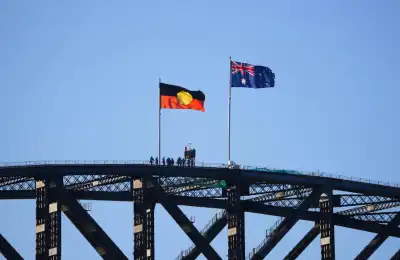
There are a total of six stars on the Australian flag. The Commonwealth Star counts as one, and the Southern Cross adds five more, giving a total of six. If you've come across figures of "seven" before, this usually refers to the number of points on the Commonwealth Star, rather than the number of stars on the flag itself.
What Do the Stars on the Australian Flag Represent?
As covered above, the stars on the Australian flag speak to two different but equally important ideas. The Commonwealth Star represents Australia's states and territories — its political geography. The Southern Cross represents its physical geography: Australia's location beneath the stars of the Southern Hemisphere. Together, the stars on the Australian flag offer a concise picture of what Australia is and where it belongs.
Australian Flag Colours
The Australian flag colours are blue, red, and white. These come directly from the Union Jack and are shared by a number of national flags with British heritage. The dominant colour is a deep navy blue, sometimes referred to informally as "Australian Blue," which forms the entire background of the flag.
Green and gold, widely associated with Australia, don't appear on the national flag. Those are Australia's national sporting colours, worn by athletes at international competitions and used across a wide range of official contexts, but they've never been part of the flag's design. The distinction is a common source of confusion, particularly for those new to learning about Australian national symbols.
Australian Flag Facts
There's plenty more to discover about the flag beyond its basic design. Here are some interesting facts worth knowing:
- The flag was first officially flown from the dome of the Royal Exhibition Building in Melbourne on 3 September 1901, a date now observed as Australian National Flag Day.
- Five different entrants in the 1901 design competition submitted virtually identical winning designs, a remarkable coincidence that led to the prize being divided between them.
- Australia is one of a small number of countries whose national flag incorporates another country's flag within its design.
- The Flags Act 1953 specifies the exact proportions and specifications of the flag, ensuring consistency across all official uses.
- The Australian Aboriginal Flag, a striking design featuring a black upper half, a red lower half, and a yellow circle in the centre, was proclaimed an official national flag under the same Act in 1995. The red and black flag with a yellow circle is widely recognised as one of the most powerful symbols of Aboriginal Australian identity and culture.
- Australia has never held a formal referendum on changing its flag, despite the debate having run for several decades.
Why Does Australia Fly Three Flags?

In many official settings across Australia, you'll notice three flags displayed together. These are the Australian National Flag, the Australian Aboriginal Flag, and the Torres Strait Islander Flag. This practice reflects a growing commitment to recognising the full breadth of Australia's national identity, including its Indigenous heritage, alongside its colonial and settler history.
All three are officially recognised as national flags of Australia under the Flags Act, giving each equal legal standing. Flying all three together is increasingly common at government buildings, sporting events, and public ceremonies, and it sends a clear message about the kind of country Australia is working to be.
The Debate Over a New Flag
Why Hasn't Australia Removed the Union Jack?
The question of whether to redesign the flag has been raised repeatedly over the years, particularly as conversations about Indigenous recognition have grown louder and Australia's sense of independent identity has strengthened. Those who advocate for a new flag of Australia argue that the current design doesn't represent the country's multicultural, post-colonial identity. They propose designs that incorporate Indigenous symbols or remove the Union Jack entirely.
Those who prefer to keep the existing flag often point out that it's a genuine piece of history, a document of Australia's origins, and that changing it risks erasing important chapters of the national story. There's also the practical argument that flags carry enormous emotional weight for the people who've grown up with them, and that change, if it comes, should be the result of broad community consensus rather than a top-down decision.
As things stand, the flag hasn't changed since its original design, and no referendum on the matter has been scheduled.
What Is the Black Australian Flag?
The Australian Aboriginal Flag, often referred to as the black Australian flag, was designed by Luritja artist Harold Thomas in 1971. The black upper half represents the Aboriginal people of Australia. The red lower half represents the earth and a spiritual connection to the land and to ochre, which holds ceremonial significance. The yellow circle at the centre represents the sun, the giver of life.
Since its creation, the Aboriginal Flag has become one of the most widely recognised and emotionally significant symbols in Australia. Its proclamation as an official national flag in 1995 was a landmark moment in the recognition of Aboriginal identity and culture.
Which Country Has a Similar Flag?
New Zealand is the country whose flag is most often confused with Australia's, sometimes to the considerable frustration of both nations. Both flags feature the Union Jack in the upper left corner and the Southern Cross on a blue background. At a glance, it's easy to see how the mix-up happens, and it's led to some well-publicised errors at international events over the years.
The differences, once you know them, are clear enough. New Zealand's Southern Cross has only four stars, all of them five-pointed and outlined in red with white borders. Australia's Southern Cross has five stars, and the flag also includes the Commonwealth Star beneath the Union Jack, something absent from New Zealand's design. The background blue on Australia's flag is also a slightly darker shade.
Flag Rules and Etiquette
Why Is the Australian Flag Not Allowed to Touch the Ground?
The tradition of keeping a national flag from touching the ground is observed in many countries, and Australia is no exception. It's considered a mark of respect for everything the flag represents: the people, the history, and the values of the nation. In Australia, official guidelines set out how the flag should be displayed, stored, and treated, and allowing it to touch the ground is generally considered a sign of disrespect. While there's no criminal penalty for doing so in most circumstances, it's widely regarded as inappropriate in public and official settings.
What Flags Are Illegal to Fly in Australia?
Australia doesn't have a blanket ban on flying foreign flags, and private individuals are broadly free to display flags on their own property. However, there are restrictions in various states and territories around flags or symbols associated with proscribed organisations, or those that may be used in a threatening or offensive manner. Local council regulations can also apply in certain areas. If you're ever unsure about flying a particular flag in a specific location, it's always worth checking the relevant state or territory legislation beforehand.
Recommended for you!
Best Sellers






Study Heraldry for £29
The history of the Australian flag is just one small thread in the vast, captivating world of heraldry and national symbols. If this topic has sparked something in you — a curiosity about what flags, coats of arms, and emblems really mean and where they come from — the Heraldry Diploma Course at Centre of Excellence is the ideal next step. You'll explore the origins of symbols, the history of heraldry, the language of coats of arms, and much more, all at your own pace and from wherever you are in the world. Enrol now for just £29!