The flag of Azerbaijan may look simple, but it carries a surprising amount of history, culture and meaning in every stripe. If you've ever wondered what those bright colours stand for, or why a crescent and an eight-pointed star sit in the middle of the red band, you're in the right place.
What's in this Guide?
This guide explores where Azerbaijan's flag came from, what each colour symbolises, and who's credited with designing it. You'll also discover how the flag has changed over the years and how it reflects the country's culture today.
Jump to:
- What is the Flag of Azerbaijan?
- What Does the Azerbaijan Flag Represent?
- The Azerbaijan Flag’s Meaning: Colours and Crescent
- Who Designed the Flag of Azerbaijan?
- What Was the Flag of Azerbaijan Before?
- The Transcaucasian Flag and a Changing Region
- What Is the Significance of the Azerbaijan Flag?
- Flag Etiquette and Everyday Life in Azerbaijan
- Study Heraldry for £29
What is the Flag of Azerbaijan?
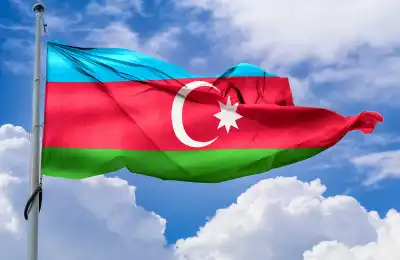
The flag of Azerbaijan is a horizontal tricolour made up of three equal bands: sky blue on top, red in the middle, and green on the bottom. In the centre of the red stripe sits a white crescent moon and an eight-pointed star. It's a flag that feels both modern and ancient at the same time.
Every element has been carefully chosen to reflect the country's identity. Azerbaijan sits at the crossroads of Eastern Europe and Western Asia, tucked between the Caucasus Mountains and the Caspian Sea. Its flag reflects that unique position, gathering influences from Turkic, Islamic and European traditions into one balanced design.
What Does the Azerbaijan Flag Represent?
Ask any Azerbaijani what their flag means, and you'll usually hear a version of the same answer: it represents the nation's Turkic heritage, its Islamic faith, and its progress as a modern country. Those three ideas map neatly onto the three stripes.
What makes the flag so meaningful is that it doesn't place any one of these elements above the others. Azerbaijan's identity is a blend, and the flag treats each strand with equal respect. This balance is part of why the design has endured, even as the country itself has navigated enormous political change over the past century.
The Azerbaijan Flag’s Meaning: Colours and Crescent
Sky Blue: Turkic Heritage
Blue has long been associated with Turkic peoples. It's the colour of the sky, of open steppes and distant horizons, and it appears in the banners and traditions of many Turkic nations. By placing sky blue at the top of the flag, Azerbaijan is honouring its roots and acknowledging its deep cultural ties with the wider Turkic world.
Red: Progress and Modernity
The red stripe in the middle represents modernisation and the country's journey toward a progressive, forward-looking society. Red is often used in flags to symbolise bravery and bloodshed, but in the Azerbaijani context, it's more about rebirth and building something new. It reflects the energy of a nation stepping into its own.
Green: Islamic Faith
Green is a colour closely associated with Islam, and in Azerbaijan's flag it represents the country's Muslim heritage. It also speaks to broader ideas of peace, nature and renewal. Around 97 per cent of the population identifies as Muslim, so this stripe acknowledges a faith that has shaped the country's traditions, architecture and festivals for generations.
The Crescent and Eight-Pointed Star
Sitting in the middle of the red band, the white crescent moon and eight-pointed star add one more layer of meaning. The crescent is a well-known Islamic symbol, while the eight-pointed star has several interpretations. Some believe it represents the eight branches of the Turkic peoples. Others link it to the letters of the word "Azerbaijan" as written in older Arabic script.
Who Designed the Flag of Azerbaijan?
The flag is traditionally credited to Ali bey Huseynzade, an Azerbaijani intellectual, writer and political thinker who lived from 1864 to 1940.
Huseynzade was a fascinating figure. He studied in Saint Petersburg and Istanbul, spoke several languages, and spent much of his life championing a philosophy he described as "Turkification, Islamisation and Modernisation."
If that sounds familiar, it's because those three ideas are exactly what the three stripes of the flag came to represent. His thinking deeply influenced the young Azerbaijan Democratic Republic, and the tricolour he helped inspire became its national banner.
Mammad Amin Rasulzade, often called the founding father of modern Azerbaijan, also played an important role in promoting the flag and the ideals behind it. Between them, these thinkers gave the country a visual identity that captured its past, present and future.
What Was the Flag of Azerbaijan Before?

Azerbaijan's flag has changed several times over the years, shaped by the region's complex political history. If you're curious about what the flag of Azerbaijan was before, you need to look at the twentieth century, which brought more than a few dramatic shifts.
Here's a timeline to help make sense of it all:
- Pre-1918: The territory was part of the Russian Empire and didn't have its own national flag in the modern sense.
- 1918–1920: The short-lived Azerbaijan Democratic Republic adopted the sky blue, red and green tricolour with the crescent and star. This was the first time the current design flew as a national flag.
- 1920–1922: After Soviet forces took control, a red banner with Soviet symbols replaced the tricolour.
- 1922–1936: Azerbaijan was part of the Transcaucasian Socialist Federative Soviet Republic, which had its own flag.
- 1936–1991: Several Soviet-era flags were used, all featuring red backgrounds with hammer-and-sickle imagery and Cyrillic lettering.
- 1991 onwards: Following independence, Azerbaijan restored the original 1918 tricolour as its national flag.
The flag that flies today is the same one the country raised when it first declared independence over a century ago. When Azerbaijan regained its sovereignty in 1991, the decision to bring back the tricolour was a way of reconnecting with that earlier moment of self-determination.
The Transcaucasian Flag and a Changing Region
You can't really tell the story of Azerbaijan's flag without touching on the Transcaucasian flag. Between 1922 and 1936, Azerbaijan, Armenia and Georgia were grouped together into a single Soviet entity called the Transcaucasian Socialist Federative Soviet Republic. The flag of this union was red, featuring a hammer and sickle along with the letters "ЗСФСР" (the Russian abbreviation for the republic's name).
This was a period when the three South Caucasian nations shared a political identity on paper, even though their cultures, languages and traditions remained distinct. The Transcaucasian flag is a reminder of that chapter, and of how often this part of the world has seen its borders and banners redrawn. For Azerbaijan, the return to the 1918 tricolour in 1991 felt like the closing of a very long detour.
What Is the Significance of the Azerbaijan Flag?
The significance of the Azerbaijan flag today lies in its history and emotional weight. It's a symbol of independence, resilience and national pride, and is still central to modern Azerbaijani life:
- State Flag Day is celebrated every year on 9 November, marking the date in 1918 when the tricolour was first adopted.
- The National Flag Square in Baku was once home to one of the tallest flagpoles in the world, standing at 162 metres.
- The flag is protected by law, and there are clear rules about how it should be displayed, folded and handled.
- It's used in international contexts ranging from the Eurovision Song Contest to the Olympic Games, where it proudly represents the nation on the global stage.
The Azerbaijan flag is a living symbol that Azerbaijanis look to during moments of celebration, mourning and everything in between.
Recommended for you!
Best Sellers





Flag Etiquette and Everyday Life in Azerbaijan
One thing that often surprises visitors is just how often you'll see the flag in daily life. It's hung from balconies, painted on walls and printed on clothing, especially around national holidays. Children learn the meaning of each colour at school, and pride in the flag is instilled from an early age. There are also some interesting rules around how the flag should be treated:
- It shouldn't ever touch the ground.
- It should always be raised with care and lowered respectfully.
- When displayed with other flags, it must be positioned in a place of honour.
- Damaged flags should be retired rather than reused.
Study Heraldry for £29
The world is full of flags, crests and emblems, each with its own story waiting to be uncovered. You can dive much deeper into the fascinating world of symbols, coats of arms and national identities with the Heraldry Diploma Course from Centre of Excellence, available for a discounted price of just £29!