For centuries, tales spread through Central Africa of a mysterious animal said to roam the dense rainforests – a creature with the body of a horse, the markings of a zebra, and the grace of a giraffe.
Some called it a myth and a cryptid – an animal not proven to exist by science. But as it turns out, the African unicorn was real all along. The okapi, or Okapia johnstoni, is one of the most fascinating and elusive animals on Earth, and its story from myth to discovery is as intriguing as the creature itself.
Jump to:
- The Discovery of a Legend
- What Is an Okapi?
- Why Are Okapis Called African Unicorns?
- The Okapi’s Unique Appearance
- What Makes the Okapi Special?
- Personality and Intelligence
- Are Okapis Aggressive?
- The Okapi’s Lifespan and Lifestyle
- The Okapi in Culture and Literature
- What Is the Significance of the Okapi?
- Lesser-Known Facts About the Okapi
- From Myth to Modern Conservation
- Study Cryptozoology for £29
The Discovery of a Legend
Before the okapi was scientifically recognised in the early 20th century, it lived mainly in the stories of local tribes in what is now the Democratic Republic of the Congo. For generations, these people spoke of a shy, forest-dwelling creature that few outsiders had ever seen. European explorers dismissed the tales, believing the African unicorn to be no more than myth.
That changed in 1901 when British explorer Sir Harry Johnston obtained skins and skulls from the Congo’s Ituri Rainforest. When scientists examined them, they realised this was no horse, zebra, or giraffe; it was something entirely unique. The okapi had officially stepped out of legend and into reality.
What Is an Okapi?
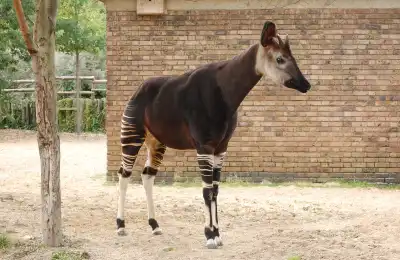
At first glance, the okapi resembles a zebra-giraffe hybrid. It has the elegant neck and large, curious eyes of a giraffe, but the compact body and striped legs of a zebra. In truth, though, the okapi isn’t related to zebras at all. Its closest living relative is the giraffe.
The okapi is not a crossbreed; it’s its own species. Both the giraffe and okapi belong to the Giraffidae family, sharing a common ancestor millions of years ago.
Why Are Okapis Called African Unicorns?
The nickname “African unicorn” comes from the okapi’s almost mythical reputation. For centuries, it was thought to be a creature of legend, hidden deep within the forests. Even today, its secretive habits and solitary nature make it hard to study in the wild. Many people never see one in their lifetime, not even those who live near its habitat.
This sense of mystery, combined with its gentle presence and graceful appearance, has given the okapi an almost magical reputation, bridging the gap between myth and science.
The Okapi’s Unique Appearance
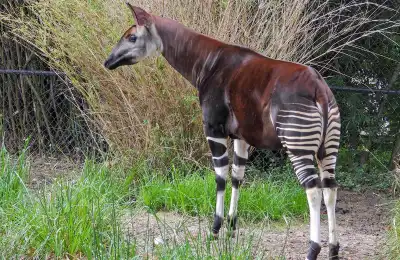
If you’ve ever seen an animal with zebra-striped legs and a velvety brown coat, you’ve likely seen an okapi. Its distinctive stripes act as camouflage, helping it blend into the filtered light of the rainforest. The stripes also help calves recognise and follow their mothers through the dense foliage.
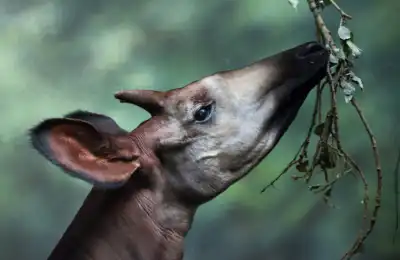
Its tongue is another remarkable feature. Like the giraffe, the okapi’s tongue is long and dark blue in colour. It can reach up to 45 centimetres, allowing the okapi to strip leaves and buds from branches, and even clean its own eyes and ears.
What Makes the Okapi Special?
Here are a few fun facts that highlight just how extraordinary the okapi is:
- It has four stomachs, like a cow, to help digest tough, fibrous plant material.
- Their tongues are prehensile, meaning they can grasp and pull food with precision.
- They are surprisingly quiet. Okapis communicate using infrasound – low-frequency sounds too deep for humans to hear.
- Each okapi has unique stripes, much like a human fingerprint.
- They produce an oily secretion that keeps their fur waterproof in the damp rainforest.
These adaptations allow the okapi to live comfortably in one of the world’s most challenging environments.
Personality and Intelligence
Okapis are known to be gentle and highly alert. They spend most of their lives alone, marking their territory with scent glands on their feet. Despite being shy, they’re also remarkably intelligent and sensitive to their surroundings.
Okapis are intelligent animals in many ways. Their ability to navigate the dense forest, avoid predators, and communicate subtly through infrasound all point to a high level of environmental awareness. In captivity, they quickly learn to recognise their keepers and adapt well to routine care, showing strong memory and problem-solving ability.
Are Okapis Aggressive?
Unlike many large animals, okapis are not aggressive by nature. They prefer solitude and peace, avoiding conflict whenever possible. Males can become territorial during mating season, but physical aggression is rare and usually limited to displays of dominance rather than real fights.
The Okapi’s Lifespan and Lifestyle
In the wild, okapis typically live between 20 and 25 years. In captivity, where they are protected from predators and disease, some have lived even longer.
Okapis are most active during the early morning and late afternoon, spending their days feeding on over 100 different plant species. They rely heavily on their sharp hearing and keen sense of smell, which help them detect danger long before they see it.
The Okapi in Culture and Literature
You may have heard of the okapi through The Poisonwood Bible by Barbara Kingsolver, where it appears as a symbol of mystery and the untamed beauty of Africa. The animal represents both innocence and resilience, reminding us of the natural world’s endurance amid human conflict and misunderstanding.
Beyond literature, the okapi also carries meaning in various contexts. Spiritually, the okapi symbolises inner peace, awareness, and the ability to navigate unseen paths. Because it lives quietly and unseen in dense forests, it’s often viewed as a totem for intuition and self-trust.
What Is the Significance of the Okapi?
On a broader scale, the okapi plays an important role in maintaining the balance of its ecosystem. By feeding on a wide range of plants, it helps regulate forest growth and promote diversity. Ecologically, it’s a keystone species, meaning its wellbeing reflects the health of the rainforest itself.
Lesser-Known Facts About the Okapi
Here are a few lesser-known facts that show just how special this animal really is:
- The okapi’s scientific name, Okapia johnstoni, honours Sir Harry Johnston, the explorer who helped introduce it to the world.
- Their calves hide for the first few weeks of life rather than following their mothers immediately, which helps them avoid predators.
- The okapi’s ankle bones are shaped in a way that’s unique to the giraffe family, proving their close relation.
- Despite their large size, okapis can move almost silently through the forest.
- They have scent glands between their toes that help mark trails and territory.
From Myth to Modern Conservation
Today, the okapi faces threats from habitat loss, illegal hunting, and human encroachment. Classified as endangered, it’s protected by law, and conservation efforts in the Congo aim to secure its survival. Sanctuaries such as the Okapi Wildlife Reserve are vital to keeping this species from slipping back into legend.
The story of the okapi, from myth to scientific discovery and ongoing conservation, is a powerful reminder of how fragile and precious the natural world truly is.
Recommended for you!
Best Sellers






Study Cryptozoology for £29
If the story of the okapi has inspired you to explore more about mysterious or once-mythical creatures, you’ll love our Cryptozoology Diploma Course. This online course explores the study of hidden or undiscovered animals, from folklore legends to creatures later proven real, just like the okapi. Enrol today for a discounted price of £29!