Many people keep a small charm in a pocket, place a horseshoe above the door, or choose a pendant that feels protective. These are often thought of as lucky charms.
This guide offers practical suggestions to help you choose good luck symbols that feel authentic to you. We’ll teach you about intention-setting and manifestation throughout, so your symbols support real action.
Jump to:
Recommended for you!
Best Sellers






What Is a Lucky Symbol?
A lucky symbol is a small object, picture, or sign you choose to stand for something positive: safety, love, success, or abundance. It might be a coin in your pocket, a pendant, or a sticker on your notebook. Think of it as a gentle reminder: whenever you see or touch it, you remember what you’re aiming for. A charm keeps your goal at the front of your mind, so you’re more likely to take the next sensible step: speaking up in a meeting, finishing a task, or keeping to a budget.
If you’re interested in manifestation, pairing a charm with a short daily practice (one clear sentence said aloud, a quick visualisation, or a mindful breath) links symbol and action so that your good luck sign becomes a cue to do the next helpful thing.
The most popular good luck charms include:
- Horseshoe: Home protection and welcome.
- Four-leaf clover: Serendipity and joyful finds.
- Maneki-neko: Customers, opportunity, cheerful flow.
- Hamsa: Protective palm, blessings, safe travels.
- Nazar: Warding off ill will.
- Jade coin or bangle: Prosperity and well-being.
- Daruma doll: Goal-setting and persistence.
- Elephant: Wisdom, long-term success, family good fortune.
- Cornicello (Italian horn): Traditional protection and luck.
Good Luck Symbols in Religion & Spirituality
Across faiths and spiritual practices, symbols carry layers of meaning (devotion, wisdom, compassion, protection), so many naturally function as lucky symbols. Their power is not in forcing events, but in reminding you to act with integrity and courage.
Christianity
Christian traditions often use the cross as a quiet sign of luck, faith and protection. Some wear the ichthys (fish) as a discreet emblem of guidance and hope. These tokens can support calm decision-making and compassionate choices, qualities that open doors in everyday life.
Buddhism
Lucky Buddhas are common in Buddhism, especially the smiling, pot-bellied figure known as Budai or Hotei in East Asian folklore. He represents abundance, generosity and contentment. Strictly speaking, he isn’t the historical Buddha, but a joyful monk associated with prosperity and ease. Keeping a small lucky Buddha statue is thought to invite cheerful energy. Some people also wear lucky Buddha necklaces or jewellery to bring good fortune with them.
Hinduism
Hindu symbols such as Ganesha, remover of obstacles, and Lakshmi, associated with beauty and prosperity, are widely admired as prosperity symbols. The Sri Yantra, a geometric meditation pattern, is used to centre the mind on harmony and abundance. These symbols pair naturally with manifestation habits, such as a few minutes of focused breathing before work, repeating a value-led affirmation, or writing a short intention.
Judaism & Islam (and beyond)
The Hamsa, also known as the Hand of Fatima or Hand of Miriam, is a protective palm motif common across Judaism and Islam, and throughout North Africa and the Middle East. Meanwhile, the Nazar (blue “evil-eye” bead) appears across the Mediterranean as a sign of watchful protection.
Good Luck Symbols in Different Cultures
Cultural charms are objects shaped by history, faith and everyday life. Choosing thoughtfully means appreciating origins and meanings, then respectfully adapting what resonates with you.
Chinese Symbols for Good Luck
There are many popular Chinese symbols for good luck that combine auspicious colours and meaningful shapes. The character Fu (福) expresses good fortune and is sometimes displayed upside-down to signal that luck has arrived. Strings of Chinese coins tied with a red cord are kept near a register or desk as a lucky symbol for money, while red knotwork, paper cuttings, and spring couplets during the New Year mirror the idea of a fresh start.
Japanese Symbols for Good Luck
In Japan, the Maneki-neko, or beckoning cat, greets customers and suggests welcome and prosperity. Daruma dolls help with goals: colour one eye while setting a clear intention; when the goal is met, colour the second eye. Omamori, amulets from shrines and temples, are kept for study, travel, or health. Chosen wisely, these Japanese symbols support steady routines and good fortune.
European & UK Symbols for Good Luck
The UK and Europe have plenty of their own lucky symbols. A horseshoe above the door, facing upward, suggests keeping luck in the home. Acorns and oak leaves symbolise growth and resilience. In much of the UK, black cats are considered fortunate companions, despite some believing black cats to be unlucky. Pennies found on the ground are small prompts to be attentive and grateful. The rare 4-leaf clover remains one of the most popular symbols of good luck; many people tuck a preserved leaf into a wallet or locket as a lucky item.
African & Mediterranean Symbols for Good Luck
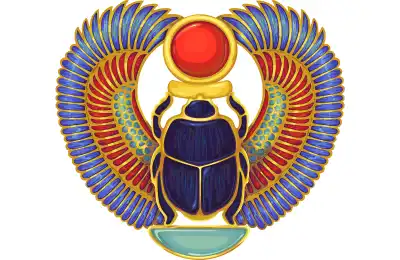
African symbols, including the scarab from ancient Egypt, express good fortune, transformation, and renewal. Olive branches and pomegranates across the Mediterranean represent peace and fruitfulness.
Nature & Everyday Signs for Good Luck
Sometimes the signs for good luck are simply moments in nature and everyday life. Some powerful good luck signs include:
- Ladybirds landing on you
- Rainbows after a storm
- Shooting stars
- A double-yolk egg
- A friendly robin in the garden
Good Luck Symbols in Astrology

There are astrological symbols that some people believe to be lucky. You can carry them around with you in the form of jewellery or decorate your home with statues and ornaments
Planetary Symbols
Many people resonate with the astrological planets for different reasons. Take a look at these lucky astrological symbols below and see what you're drawn to:
- Sun: Confidence and recognition
- Moon: Care and routine
- Mercury: Learning, writing, trade
- Venus: Love, art, ease with money
- Mars: Courage and momentum
- Jupiter: Growth, opportunity, prosperity
- Saturn: Discipline and long-term success
Zodiac Glyphs
- Aries: Fresh starts
- Taurus: Steady finances
- Gemini: Communication
- Cancer: Home and care
- Leo: Visibility
- Virgo: Organisation
- Libra: Balance and partnerships
- Scorpio: Transformation
- Sagittarius: Learning and travel
- Capricorn: Structure and career
- Aquarius: Innovation and community
- Pisces: Compassion and imagination
Planetary Days
Linking small tasks to the planet of each day can help increase your fortune as you live in tune with the planets:
- Sunday (Sun): Plan one act that builds confidence.
- Monday (Moon): Tidy a space or journal briefly.
- Tuesday (Mars): Take a decisive step on a stalled task.
- Wednesday (Mercury): Write, study, negotiate, or organise travel.
- Thursday (Jupiter): Review goals or finances, ideal for placing a Jupiter talisman or coin charm by your desk as a good fortune symbol.
- Friday (Venus): Nurture relationships or creative work.
- Saturday (Saturn): Set boundaries, budget time, and prepare for the week.
Stones and Metals
If you’re exploring stones that bring good luck, you could try matching a stone to a planet’s qualities: sunstone for the Sun (confidence), moonstone for the Moon (calm), emerald or green aventurine for Mercury (study and trade), rose quartz for Venus (love and harmony), carnelian or tiger’s eye for Mars (courage), citrine or amethyst for Jupiter (optimism and growth), and onyx or hematite for Saturn (discipline). Keep one where you’ll see it, on your desk, in a pocket, or as jewellery, and pair it with a single sentence of intention each morning.
Metals can echo the theme in a simple way: gold-tone for the Sun, silver-tone for the Moon, copper for Venus, iron-coloured accents for Mars, and tin-like finishes for Jupiter.
Bad Luck Symbols
Across different cultures, certain everyday actions and numbers are thought to bring misfortune, and these superstitions continue to influence beliefs today.
- Breaking a mirror: In European folklore, breaking a mirror is thought to bring seven years of bad luck, as mirrors were once believed to reflect not only your appearance but also your soul, so damaging one was seen as damaging your own fortune.
- Walking under ladders: Walking under a ladder is considered unlucky because it is unsafe, but also because the triangle formed between the ladder and the wall was once thought to symbolise the Holy Trinity, and passing through it could be seen as breaking that sacred symbol.
- Opening an umbrella indoors: Opening an umbrella inside was once thought to offend household spirits or bring bad luck to the home, as umbrellas were traditionally used for protection from the elements and their unnecessary use indoors was seen as inviting misfortune.
- Number 13: In many Western cultures, the number thirteen is considered unlucky, often linked to religious and historical associations such as the thirteen people at the Last Supper, which has led to its avoidance in house numbers, hotel floors, and dinner parties.
- Number 4: In several East Asian countries, the number four is avoided because in languages such as Mandarin, Cantonese, and Japanese, it is pronounced very similarly to the word for death, making it an uncomfortable number for room numbers, phone numbers, and lifts.
- Spilling salt: Spilling salt is often thought to attract bad luck or evil spirits, but tradition says this can be reversed by tossing a pinch of the spilt salt over your left shoulder, where it was believed the devil might be lurking.
If you accidentally trigger a superstition, a small balancing ritual, tidying the space, speaking a positive intention, or doing a kind act can help restore a sense of calm.
How do You Use a Lucky Symbol in Manifestation?
A lucky symbol can become a practical tool in your manifesting routine. It works as a gentle reminder of your goals and keeps you aligned with the energy you want to attract. You can use your lucky symbol in the following ways:
1. Set a Clear Intention
Begin by giving the object a clear job. Decide what this symbol will stand for (calm interviews, steady finances, kinder communication, consistent study), then write that intention on a small card or in a notes app. You could activate the symbol with a simple ritual: Hold it, take one slow breath in and out, and read your intention once. Keep the words practical and brief: “I act with calm confidence,” or “I notice opportunities and make wise money choices.”
2. Place It Where Action Happens
Position the symbol where you will actually see or touch it during the task it supports. A lucky money symbol belongs by your wallet or desk, a study charm sits on your notebook, and a lucky relationship token lives near the front door or on your phone’s lock screen. Placement matters because manifestation works best when the reminder appears at the moment you can act.
3. Link the Symbol to a Tiny Behaviour
Use an “if–then” pattern: If I see the charm, then I do the next small step. Examples include sending one email, moving £5 into savings, reading a single revision card, or taking a calming breath before you speak. This converts a good fortune symbol into a habit trigger, which is where momentum begins.
4. Visualise a Single Success
After reading your intention, picture one realistic scene that proves it’s working: the sent email, the completed worksheet, the tidy budget, the calm conversation. Keep the image tight and then take the smallest action that moves you towards it.
Recommended for you!
Best SellersFrequently Asked Questions
What Is the Luckiest Symbol?
The four-leaf clover and horseshoe are among the most recognised globally, while the Hamsa, Maneki-neko, and Chinese coins are strong contenders in many regions. The symbol that speaks to your values and helps you act with courage and care is the best good luck symbol for you.
How long should I use a symbol before expecting results?
Give your routine two to four weeks: notice the symbol, take the next sensible step, and keep a brief note of wins. Progress usually shows up as steadier habits first, then outcomes.
Can I have more than one lucky symbol?
Aim for one symbol per goal so each object has a clear “job”. For example, a coin string or Jupiter talisman for prosperity, a small Mercury charm on a pen cap for communication, and a heart or Venus pendant for relationships. Keeping to three helps your attention stay sharp and reduces decision fatigue.
Is it okay to use symbols from other cultures?
It’s okay to use lucky symbols from other cultures, so long as you’re respectful. Start by learning the name, story, and customary use. Credit the origin when you talk about it, and avoid treating sacred imagery as decoration or a trend. If there are guidelines for placement or handling, such as how to display a Hamsa or where a particular emblem should sit, follow them. When possible, buy from makers in the originating community so your purchase supports the culture that created the symbol.
What’s the best way to gift a good luck charm?
When gifting a good luck charm, make the meaning explicit so the gift feels personal rather than random. Include a short note that explains the symbol, its origin, and the intention you wish for the recipient. Add one simple suggestion for use, “keep by your desk and touch before calls”, or “place near your wallet and move £5 to savings when you notice it”, so the charm becomes a practical prompt rather than an ornament.
Study Our Manifesting Your Dreams Diploma for £29
Symbols are most powerful when they are paired with intention and action. If you’d like structured guidance on setting goals, building supportive habits, and using simple manifestation techniques alongside your chosen charms, study the Manifesting Your Dreams Diploma Course with Centre of Excellence. Follow the link to access the course for a discounted price of £29!