Few creatures have captured human imagination quite like the giant squid. Elusive and incredibly powerful, it has long been the inspiration behind sea monster legends and maritime myths. For centuries, sailors told tales of enormous tentacled beasts rising from the deep to drag ships under the waves. Today, science confirms that giant squids are real; yet, much about them remains hidden beneath the ocean’s dark surface.
If you’ve ever wondered whether these legends hold truth, or when the giant squid was discovered, this article will take you through everything you need to know, from myth to modern discovery.
Jump to:
- What Is a Giant Squid?
- The Myth of the Giant Squid
- Are Giant Squids Real, or Just a Myth?
- Theories About the Giant Squid
- When Was the Giant Squid Discovered?
- Sightings and Encounters
- Are Giant Squids Dangerous?
- Why Do We Never See Giant Squid?
- Has a Giant Squid Ever Been Seen Alive?
- What Is the Largest Giant Squid Ever Found?
- Giant Squid vs Colossal Squid
- Interesting Facts About the Giant Squid
- Why Is the Giant Squid Not Edible?
- What to Do If a Giant Squid Grabs You
- Study Cryptozoology for £29
What Is a Giant Squid?
The giant squid (Architeuthis dux) is one of the largest invertebrates on Earth, capable of growing up to 13 metres long. Its body is built for life in the deep ocean, with a torpedo-shaped mantle, eight arms, and two longer feeding tentacles lined with powerful suckers. These tentacles help it capture prey such as fish and smaller squids, which it draws towards its beak-like mouth.
Despite its size, the giant squid remains one of the least understood animals on the planet. Because it lives in the deep ocean, sightings are incredibly rare, and much of what scientists know comes from carcasses washed ashore or caught in deep-sea nets.
The Myth of the Giant Squid
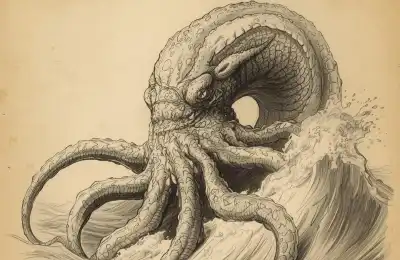
In Norse mythology, the giant sea monster known as the Kraken was said to dwell off the coast of Norway and Greenland. Descriptions of the Kraken match many details of the modern giant squid, and the name “Kraken” itself has since become synonymous with the idea of a giant sea creature lurking in the deep.
These myths likely arose from real encounters. When large squids or parts of their bodies surfaced, early sailors, who were unfamiliar with such animals, may have mistaken them for supernatural beings. Over time, the stories grew more dramatic, feeding into centuries of maritime folklore.
Are Giant Squids Real, or Just a Myth?
Many believed the giant squid was a sailor’s exaggeration, a figment of imagination inspired by fear of the unknown. Early reports described squid monsters attacking boats, wrapping their tentacles around ships, and dragging them beneath the waves. This led people to believe that the Giant Squid was a cryptid – a creature whose existence is unproven by science.
Today, we know these creatures are real. Scientists confirmed their existence in the 19th century when physical remains, including tentacles and entire specimens, began washing ashore.
Theories About the Giant Squid
For years, scientists debated whether such a creature could exist at all. Before photographic proof, some believed the stories were confused sightings of whales and other marine animals.
Modern theories focus on how these creatures survive in the ocean’s harshest environments. The giant squid’s huge eyes, for example, help it detect movement in almost complete darkness, particularly the bioluminescent glow of predators like sperm whales. Others believe their massive size evolved as an adaptation to the deep-sea “gigantism” phenomenon, where cold, high-pressure conditions favour large body forms.
When Was the Giant Squid Discovered?
The first confirmed scientific description of the giant squid came in the mid-19th century. In 1857, Danish naturalist Japetus Steenstrup analysed beached remains and formally identified the species Architeuthis dux. This marked the transition of the giant squid from myth to measurable fact.
In 2004, researchers captured the first-ever photographs of a living giant squid in its natural habitat, followed by video footage in 2012. These giant squid photos offered the world a rare glimpse of this mysterious animal alive in the deep.
Sightings and Encounters
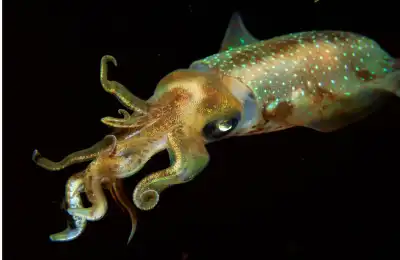
Although sightings are rare, the few documented encounters have amazed scientists and the public alike. The first known footage showed a giant squid wrapping its long tentacle around a camera in the deep ocean. Later expeditions recorded similar images, revealing its graceful, almost alien movement.
In history, reports of giant squid attacks on ships have circulated. While there is no verified evidence of a giant squid attack, the stories likely originated from encounters with dying or stranded squids struggling at the surface.
Are Giant Squids Dangerous?
Giant squids are not known to attack humans. While their suckers and beaks are formidable, they live in deep-sea regions far beyond human reach. Most squid attacks on humans involve smaller, more aggressive species encountered by divers.
Why Do We Never See Giant Squid?
The deep ocean is one of the most inaccessible places on Earth. Giant squids live thousands of metres below the surface, where sunlight cannot reach. This makes studying them incredibly challenging.
They are rarely caught because they move slowly and inhabit areas too deep for fishing nets. When they do surface, it’s often because they are injured or dying. This explains why we never see giant squid in their natural state, as they prefer the darkness where few creatures dare to go.
Has a Giant Squid Ever Been Seen Alive?
The giant squid has been seen alive, though only a few times. The first confirmed live sighting was in 2004 off Japan’s Ogasawara Islands, when researchers captured the first giant squid pictures. Later footage showed a magnificent orange-red squid swimming gracefully in the deep. These rare sightings confirm that such creatures, once thought mythical, are very real indeed.
What is The Largest Giant Squid Ever Found?
The largest giant squid ever recorded measured around 13 metres in length, including its tentacles. However, reports from the past suggest that even larger specimens may have existed.
Giant Squid vs Colossal Squid
The giant squid often shares the spotlight with its close relative, the colossal squid (Mesonychoteuthis hamiltoni). Although shorter in length (around 10–12 metres), the colossal squid is heavier and more muscular, with thicker tentacles and larger eyes.
In a comparison between the two, the colossal squid wins for sheer mass, while the giant squid holds the record for longer tentacles and overall reach. Both species remain extremely elusive, seen alive only a handful of times.
Interesting Facts About the Giant Squid
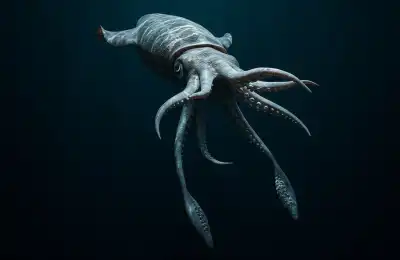
Here are some facts about the Giant Squid to spark your curiosity:
- They have three hearts. Two pump blood to the gills, while one pumps it to the rest of the body.
- Their blood is blue. It contains copper-based molecules that help carry oxygen in cold, low-oxygen waters.
- They have some of the largest eyes in the animal kingdom. Each eye can be as big as a football, allowing them to spot predators like sperm whales.
- They are powerful but delicate. Their long tentacles can stretch for metres, yet their bodies are soft and easily damaged.
- They inspired countless legends. From the Kraken of myth to modern films, the giant squid continues to symbolise the mystery of the deep.
Why Is the Giant Squid Not Edible?
While smaller squid species are commonly eaten around the world, the giant squid is not edible. Its flesh contains high levels of ammonia, which helps keep its body buoyant in the ocean but gives it an unpleasant taste and smell. For this reason, the giant squid is unsuitable for human consumption.
What to Do If a Giant Squid Grabs You
Although it’s highly unlikely you’ll ever meet one, it’s interesting to wonder what to do if a giant squid grabs you. In reality, survival would be nearly impossible in the depths where it lives. But hypothetically, struggling or cutting free from its tentacles would be the only chance, as their suction cups and sharp rings can cause deep wounds.
Thankfully, such encounters are purely theoretical. The giant squid’s natural environment is far deeper than where humans typically venture, even in submersibles.
Recommended for you!
Best Sellers





Study Cryptozoology for £29
If stories like this spark your imagination and you love mysteries that blend science and the unexplained, you’ll enjoy learning more through our Cryptozoology Diploma Course. This online course explores famous creatures, from the Giant Squid to the Loch Ness Monster, and right now, you can get the course for a discounted price of £29!