The flag of Armenia is a simple but powerful tricolour, its red, blue, and orange bands carrying centuries of national history and identity. If you've ever wondered what this flag's colours represent or where its design comes from, this guide covers its full history and meaning.
What's in this Guide?
This guide explains the history of the Armenia flag, what its colours represent, and where its design originally came from. You'll also find some quick facts about the flag's adoption and specifications and how it compares to other flags of the world.
Jump to:
The History of the Armenia Flag
The modern flag of Armenia traces back to 1885, when Ghevont Alishan, a scholar at the Armenian Institute in Venice, proposed a striped flag for Armenians living in exile, inspired by the idea of the rainbow said to have appeared over Mount Ararat in the biblical story of Noah's Ark. This early proposal eventually evolved into the red, blue, and orange design used today.
The red-blue-orange tricolour was officially adopted on 1 August 1918, when Armenia declared independence following the Russian Revolution, becoming the flag of the First Republic of Armenia. It was replaced in 1921 when the Soviet Red Army took control of the country, and a Soviet Armenian flag was used instead throughout the Soviet era. Following Armenia's move towards independence from the Soviet Union, the original tricolour was formally readopted on 24 August 1990 by the Supreme Soviet of the Republic of Armenia, based on a design by linguist and academician Stepan Malkhasyants.
What Do the Colours on the Flag Mean?
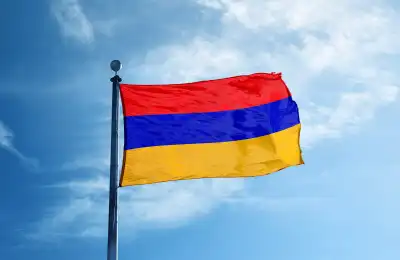
According to Armenia's constitution, each colour carries specific symbolic meaning:
- Red represents the Armenian Highlands, the historic struggle of the Armenian people to survive, and their Christian faith, independence, and freedom.
- Blue represents the will of the Armenian people to live under peaceful skies.
- Orange represents the hardworking nature and creative talent of the Armenian people, sometimes also linked to the apricot, a fruit closely associated with Armenia.
Some historical interpretations differ slightly from the official constitutional meaning, with red sometimes described specifically as representing blood shed in defence of the homeland, and orange linked to the golden wheat fields that have long sustained the country.
Where Does the Flag's Design Come From?

The flag's specific colour combination is traced back to the Cilician Armenian Kingdom under the Rubenid dynasty, which historically used red, blue, and yellow. When the modern flag was designed in the early 20th century, yellow was replaced with orange, a change generally considered to blend more harmoniously with the other two colours while still echoing this historical heritage.
Flag of Armenia: Colours, Codes & Dimensions
Armenia is one of the few countries to have published official, standardised colour values for its flag. In 2012, the Armenian National Institute of Standards (SARM) issued the following specifications:
- Red: Pantone 485, Hex #D90012, RGB 217, 0, 18
- Blue: Pantone 286, Hex #0033A0, RGB 0, 51, 160
- Orange: Pantone 1235, Hex #F2A800, RGB 242, 168, 0
- Ratio: 1:2
These specifications sit under Armenia's Law No. 149, "On the National Flag of Armenia," originally adopted on 15 June 2006 and amended several times since, most recently in 2023.
The Armenian Coat of Arms
Armenia's coat of arms, adopted on 19 April 1992, was designed by architect Alexander Tamanian and artist Hakob Kojoyan, based closely on the original coat of arms used by the First Republic of Armenia between 1918 and 1920.
At its centre sits a shield depicting Mount Ararat with Noah's Ark, a nod to the mountain's significance in Armenian national identity and the biblical flood story. The shield is divided into four sections, each representing one of four historical Armenian kingdoms, coloured in the same red, blue, and orange found on the national flag. An eagle and a lion support the shield on either side, while a sword, a branch, a sheaf of wheat, a broken chain, and a ribbon are depicted beneath it, together representing strength, peace, prosperity, freedom from oppression, and national unity.
Flags Similar to Armenia
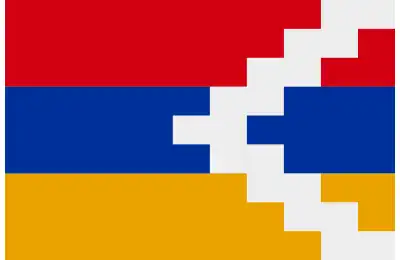
The flag most frequently compared to Armenia's is that of Nagorno-Karabakh, also known as Artsakh, a region with a majority Armenian population in neighbouring Azerbaijan. Artsakh's flag uses the same red, blue, and orange bands as Armenia's national flag, with the addition of a white zigzag pattern at the fly end, symbolising a historic Armenian carpet design as well as a visual link to the wider Armenian nation.
Fast Facts About the Flag
- First adopted: 1 August 1918, by the First Republic of Armenia
- Readopted: 24 August 1990, following Armenia's move towards independence from the Soviet Union
- Designer: Stepan Malkhasyants (1990 design)
- Ratio: 1:2
- Design: Three equal horizontal bands of red, blue, and orange
Recommended for you!
Best Sellers





Frequently Asked Questions
When Was the Armenian Flag Adopted?
The tricolour design was first officially adopted on 1 August 1918, and was readopted in its current form on 24 August 1990, following the end of Soviet rule.
What Does the Armenian Flag Symbolise?
The flag's red, blue, and orange bands represent the Armenian Highlands and the struggle for survival and freedom, peaceful skies, and the hardworking, creative nature of the Armenian people, respectively.
Why Did Armenia Choose Red, Blue, and Orange?
These colours trace back to the historical flag of the Cilician Armenian Kingdom under the Rubenid dynasty, which used red, blue, and yellow, with orange later replacing yellow for a more harmonious design.
What Was Armenia's Flag During the Soviet Era?
During the Soviet period, Armenia used a flag similar to the Soviet Union's, featuring red with a horizontal blue stripe through the centre, rather than the red-blue-orange tricolour used today.
What Is the Ratio of the Armenian Flag?
The official ratio of the Armenian flag is 1:2, meaning the flag's length is twice its width.
Study Heraldry for £29
If flags and their symbolism have sparked your curiosity, our Heraldry Diploma Course explores the history and meaning behind national and family symbols in far more depth. For a limited time, you can enrol for just £29.