
If you've ever wondered why cats like boxes, this guide is for you. It's one of the most universally recognised feline behaviours, and there's genuine science behind it that's well worth exploring.
What's in this Guide?
This guide takes a closer look at the fascinating reasons why cats love boxes, from deep-rooted survival instincts to the warmth and comfort cardboard provides. You'll also find practical advice on whether you should let your cat sleep in one.
Jump to:
- Why Are Cats So Obsessed With Boxes?
- Do Cats Feel Safe Inside Boxes?
- Can Boxes Relieve a Cat's Stress?
- Do Cats Like Boxes Because They're Warm?
- Why Do Cats Like Cardboard Boxes in Particular?
- Big Cats and Small Boxes: Is It Just Domestic Cats?
- Why Do Cats Like Sitting in Boxes That Are Too Small?
- Should I Let My Cat Sleep in a Box?
- Study Feline Behaviour and Psychology for £29
Why Are Cats So Obsessed With Boxes?
To understand why cats love boxes, it helps to think about where domestic cats come from. Their wild ancestors were both predators and prey, which meant they needed to be clever about how they navigated the world. Seeking out enclosed, sheltered spaces wasn't just a preference — it was a survival strategy.
When a cat sits inside a box, it can observe its surroundings from a position of relative safety. Its back and sides are protected, and anything approaching must come from the front. This is a deeply instinctive behaviour that's carried through thousands of years of evolution, even in the most pampered house cat who's never encountered a predator in their life.
So why do cats like boxes so much, even in the safety of a loving home? Because instinct doesn't simply switch off. The draw to enclosed spaces is hardwired, and a cardboard box on your living room floor is the perfect substitute for a cave or a dense thicket of undergrowth.
Do Cats Feel Safe Inside Boxes?
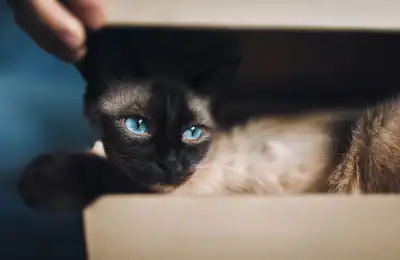
A feeling of safety is arguably the most important reason behind the behaviour. Cats aren't social animals in the same way that dogs are; they don't naturally seek out the middle of a room and make themselves visible. Instead, they're wired to seek out spaces where they feel in control of their environment.
A box provides that sense of control. Inside one, a cat can:
- Monitor the room without being easily spotted
- Rest without feeling exposed or vulnerable
- Retreat from stressors in the environment
- Feel the reassuring pressure of walls on either side
This sense of enclosure is known in animal behaviour research as a "refuge": a safe space an animal can retreat to when it feels overwhelmed, or simply needs to rest without alerting others to its presence. For cats, boxes serve exactly this function.
The "If I Fits, I Sits" Phenomenon
You've almost certainly seen the memes. A cat squeezing itself into a box three sizes too small, looking utterly content. This isn't just entertaining; it's genuine behaviour driven by the cat's desire for that enclosed, enveloped feeling. The tighter the space, the more secure a cat may feel, because there's less chance of anything sneaking up from behind.
Research has also shown that cats in shelters who were given boxes to hide in showed significantly lower stress levels and adapted to their new environment more quickly than cats without boxes. The presence of a simple hiding place made a measurable difference to their wellbeing.
Can Boxes Relieve a Cat's Stress?
This is one of the most well-supported findings in feline behavioural science. Cats experiencing stress, whether from a new environment, a change in routine, the arrival of a new pet, or even loud noises, will often seek out enclosed spaces as a coping mechanism.
Hiding isn't a sign that your cat is unhappy with you. It's a sign that your cat is doing exactly what cats are built to do: managing their own stress by removing themselves from the source of it and retreating somewhere that feels controllable.
Some signs that your cat may be using boxes (or other hiding spots) as a stress response include:
- Spending more time hiding than usual
- Only emerging to eat or use the litter tray
- Seeming reluctant to come out even when called
- Appearing tense or alert whilst inside the box
If you notice these behaviours, it's worth thinking about what might have changed in your cat's environment recently. The box itself isn't the problem; it's your cat's way of self-soothing whilst they adjust.
Do Cats Like Boxes Because They're Warm?
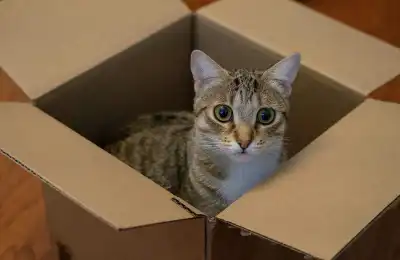
Warmth is certainly part of the appeal. Cats have a higher thermoneutral zone than humans, meaning they feel most comfortable at temperatures between roughly 30 and 38 degrees Celsius, which is considerably warmer than what most of us keep our homes at.
Cardboard, in particular, is an excellent insulator. It traps body heat efficiently, which means a cat curled up inside a cardboard box will stay noticeably warmer than one lying on a cold floor or even on a fabric surface. This makes cats in cardboard boxes a very common sight, especially in cooler weather.
So whilst warmth alone doesn't explain why cats like boxes, it's a genuine contributing factor that makes the experience even more appealing. Add together the security of an enclosed space and the comfort of retained body heat, and it's easy to see why the humble cardboard box is such an irresistible destination.
Why Do Cats Like Cardboard Boxes in Particular?
It's not just any box that attracts cats, but cardboard boxes specifically. There are a few reasons beyond the insulation factor already mentioned.
Cardboard has a satisfying texture for cats. It's firm enough to provide resistance but yields slightly under pressure, making it comfortable to rest on. More importantly, it's a material that cats can scratch, bite, and knead without causing themselves any harm. Scratching cardboard is a common way for cats to mark territory (they have scent glands in their paws), sharpen their claws, and release tension.
- Texture: Rough enough to scratch and bite, but not abrasive.
- Scent: Cardboard absorbs and retains smells, including the cat's own scent, making it feel "claimed".
- Malleability: Cats can shape and tear it, giving them a sense of agency over their environment.
- Novelty: New boxes come with new smells from packaging, tape, and transit, which are endlessly interesting to an animal driven by its sense of smell.
Big Cats and Small Boxes: Is It Just Domestic Cats?
One of the most delightful discoveries in feline research is that this behaviour isn't limited to our pets. Big cats, including lions, tigers, leopards, and cheetahs, show exactly the same attraction to boxes when given the opportunity. Big cats and small boxes have become a well-known feature of enrichment programmes at zoos and sanctuaries worldwide.
Wildlife carers regularly use cardboard boxes, wooden crates, and other enclosures as forms of environmental enrichment, and the big cats respond with exactly the same enthusiasm as your cat at home. They sit in them, roll around in them, shred them, and defend them from other animals.
This tells us something important: the box-loving behaviour isn't a quirk of domestication. It's a fundamental feline trait that spans the entire family, from a Bengal tiger to the tabby sleeping on your kitchen floor.
Why Do Cats Like Sitting in Boxes That Are Too Small?
This is a question that puzzles many cat owners. Why do cats sit in boxes that are clearly not big enough, sometimes with limbs dangling over the edges, looking thoroughly undignified but entirely unbothered?
Part of the answer lies in the pressure and contact the box provides. When the sides of a box press against a cat's body, it mimics the sensation of being in a very snug, secure space. Some animal behaviourists believe this is related to the same mechanisms that make swaddling calming for human infants. The gentle, consistent pressure triggers a sense of safety and calm.
Cats are also extraordinarily flexible. Their skeleton is designed to compress and contort in ways that would be uncomfortable for most other animals, which means what looks impossibly cramped to us may feel perfectly fine to them.
Should I Let My Cat Sleep in a Box?
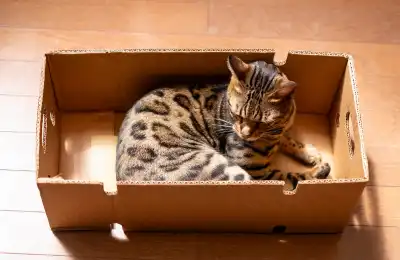
If your cat has found a clean, dry cardboard box and taken to sleeping in it, this is a completely healthy behaviour. Allowing your cat to use a box as a sleeping spot respects their natural instincts and gives them a space they feel they own. Here are a few practical things to bear in mind:
- Make sure the box is dry and free from any sharp staples or tape that could injure your cat.
- Avoid boxes that previously contained chemicals, cleaning products, or anything with strong, potentially toxic residues.
- Place it somewhere your cat can access easily without being disturbed by household foot traffic.
- If you want to encourage box use as a positive retreat, you can line it with a familiar blanket or an item of your clothing to make it more inviting.
There's no evidence that sleeping in cardboard boxes is harmful to cats. On the contrary, having a dedicated retreat space supports their emotional wellbeing and gives them a sense of security within the home.
When to Be Concerned
If your cat is hiding in a box and showing other signs of distress, such as not eating, being unusually withdrawn, or displaying changes in litter tray habits, it's worth speaking to your vet. In these cases, the hiding behaviour is a symptom of something else that needs addressing, rather than simple comfort-seeking.
Recommended for you!
Best Sellers





Study Feline Behaviour and Psychology for £29
Understanding why cats do the things they do, from sitting in boxes to the way they communicate, play, and form bonds, opens up a whole new dimension in your relationship with your pet. If this topic has sparked your curiosity, the Feline Behaviour and Psychology Diploma Course is a brilliant next step. Designed for all levels of experience, this online course takes you through the science of cat behaviour, psychology, and communication. Enrol now for just £29!




