The flag of Albania is one of the most striking national flags in the world, and if you've ever found yourself drawn to its bold design, you're far from alone. Whether you spotted it flying over Tirana, came across it during a history deep-dive, or simply want to understand the story behind that striking red and black image, this guide has you covered.
What's in this Guide?
This post covers everything you need to know about the national flag of Albania: what it looks like, what it means, where it came from, and how it's changed over the centuries. You'll also discover the deep symbolism of the eagle on the Albanian flag and learn what makes it so distinctive in heraldry.
Jump to:
What Does the Albanian Flag Look Like?
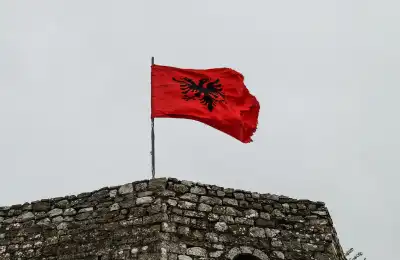
The Albanian flag is deceptively simple in its design. It features a black double-headed eagle centred on a vivid red background, with no additional colours, no stars, no crescent, and no text; just two bold elements working together.
The red is deep and saturated, sometimes described as scarlet. The eagle is solid black, its two heads facing outward in opposite directions, wings spread wide. The overall effect is dramatic and confident, which is fitting given the flag's long and turbulent history.
What Is the Meaning Behind the Albanian Flag?

The Albanian flag is rooted in identity, resistance, and ancient heritage, and symbolises the spirit of people who've weathered centuries of conflict. To understand it fully, it helps to look at both elements of the design separately.
The Colour Red
In the context of the Albanian flag, the colour red is widely understood to represent the bravery and bloodshed of the Albanian people throughout their long history of struggle against invasion and occupation. It speaks to resilience, a quality that runs through Albanian national identity.
The Eagle
The double-headed eagle symbolises strength, sovereignty, and vigilance, while the two heads facing in opposite directions are often interpreted as looking both east and west, reflecting Albania's geographic and cultural position between two worlds.
The Double-Headed Eagle: Albania's Most Powerful Symbol
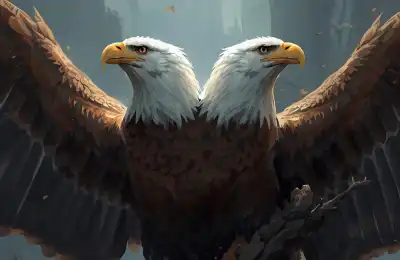
The double-headed eagle Albania uses as its central symbol is one of the oldest and most potent motifs in European heraldry. Its origins stretch back far beyond Albania itself; the image appeared in ancient Mesopotamia and was later adopted by the Byzantine Empire, where it became a mark of imperial authority.
In broader heraldic tradition, the double-headed eagle typically represents:
- Dual sovereignty: The ability to rule over two realms or look in two directions simultaneously.
- Power and dominion: The eagle has long been associated with strength and authority across many cultures.
- Watchfulness: Two heads mean nothing escapes notice, a quality prized in rulers and nations alike.
For Albanians specifically, the eagle is closely linked to the national hero Gjergj Kastrioti, better known as Skanderbeg, who led Albanian resistance against the Ottoman Empire in the 15th century. His seal featured the double-headed eagle, and his legacy cemented the symbol as the emblem of Albanian identity.
The eagle is so central to Albanian culture that Albanians refer to themselves as Shqiptarët, which some scholars link to the word for eagle (shqipe). Whether or not this etymology is entirely precise, the connection between the Albanian people and the eagle runs very deep.
The History of the Albanian Flag

From medieval heraldry to a hard-won declaration of independence, the flag's roots go deeper than most people realise and reflect the country's turbulent political journey.
Medieval Origins
The earliest use of the double-headed eagle as an Albanian symbol dates to the medieval period. When Skanderbeg united Albanian nobles to resist Ottoman expansion, the eagle became a rallying symbol for national unity. This is arguably the moment when the double-headed eagle became truly inseparable from Albanian identity.
The League of Prizren (1878)
Albanian nationalism grew significantly during the 19th century, particularly with the formation of the League of Prizren in 1878. The League sought to preserve Albanian territory and promote a distinct Albanian identity in the face of declining Ottoman control. The double-headed eagle was a central motif during this period, and variations of the Albanian flag were used as national symbols by activists and cultural figures alike.
Independence in 1912
Albania declared independence on 28 November 1912, and the flag raised by Ismail Qemali in Vlorë featured a red background bearing the black double-headed eagle, essentially the same design used today. This moment is considered the birth of the modern Albanian state, and the flag raised that day has remained the enduring symbol of the nation ever since.
The Original Albanian Flag and How It Changed Over Time
The flags of Albania have taken several different forms over the years, each one a reflection of whoever held power at the time. The original design was simple, but as the country passed through monarchy, occupation, and communism, the flag changed with it.
The Zog Era (1928–1939)
During the reign of King Zog I, the old Albanian flag changed to reflect the monarchy. A crowned helmet was added above the eagle to denote royal authority.
Communist Albania (1944–1992)
When the Communist Party took control under Enver Hoxha after World War II, the flag was altered again. A yellow-bordered red star was added above the eagle's heads, a common addition to the flags of communist states during the Cold War era. This version of the flag remained in use for nearly five decades.
The Return to Democracy (1992–Present)
When communism fell, and Albania transitioned to a democratic republic in the early 1990s, the red star was removed from the flag. The current design was restored to reflect the pre-communist flag and signal a clear break from the authoritarian past.
Recommended for you!
Best Sellers





Frequently Asked Questions
Who came up with the Albanian flag?
The modern Albanian flag is most closely associated with Ismail Qemali, who raised it at Albania's declaration of independence on 28 November 1912. Its roots, however, trace back to the 15th-century national hero Skanderbeg, whose seal featured the double-headed eagle that remains at the heart of the design today.
What is a fun fact about the Albanian flag?
Albania's Independence Day, celebrated on 28 November, is also known as Flag Day. The two are so intertwined that they're marked together as a single national occasion. The flag's eagle motif also appears throughout Albanian everyday life, from architecture and currency to folk embroidery and official seals.
Are there other flags with an eagle in the middle?
A small number of national flags feature a double-headed eagle, including those of Serbia and Montenegro, though Albania's is arguably the most widely recognised. Single-headed eagle flags are more common globally, appearing on the flags of countries such as Germany, Mexico, and Egypt.
Study Heraldry for £29
If exploring the history and meaning behind national symbols like the Albanian flag has sparked a deeper curiosity, the Heraldry Diploma Course is a wonderful next step. Right now, you can access the full course for just £29.