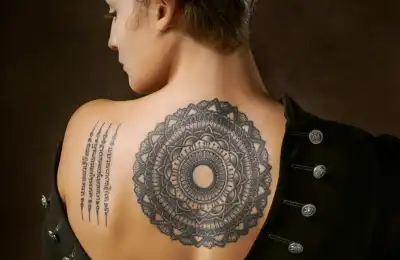
The meaning of a mandala tattoo is rooted in sacred geometry, representing balance, unity, and the interconnected nature of the universe. If you're considering a mandala tattoo, or you've seen one and wondered about the story behind it, this guide covers its symbolism, spiritual meaning, and design choices.
What's in this Guide?
This guide explains what a mandala tattoo represents, its roots in Hindu and Buddhist traditions, and how choices such as colour and placement can shape its meaning. You'll also find honest guidance on the question of cultural appropriation.
Jump to:
- What Does a Mandala Tattoo Symbolise?
- What Does a Mandala Tattoo Mean Spiritually?
- Mandala and Lotus Tattoo Meaning
- Mandala and Elephant Tattoo Meaning
- Mandala Tattoo Meaning in Hinduism and Buddhism
- Is a Mandala Tattoo Cultural Appropriation?
- Mandala Tattoo Colour Meanings
- Mandala Tattoo Meaning by Placement
- Frequently Asked Questions
- Study Symbology for £29
What Does a Mandala Tattoo Symbolise?
A mandala tattoo represents balance, unity, and wholeness. The word "mandala" comes from Sanskrit, roughly translating to "circle," and its symmetrical, geometric design reflects the idea of a universe in perfect harmony, with everything connected and in its rightful place.
Beyond balance, people choose mandala tattoos for a range of reasons, including:
- Inner peace and a sense of calm
- Protection and spiritual grounding
- A meditative reminder to return to centre
- Personal growth and the cyclical nature of life
- A connection to something greater than the self
So if you're wondering what a mandala tattoo represents, the answer usually comes down to a mix of balance, harmony, and quiet spiritual reflection.
What Does a Mandala Tattoo Mean Spiritually?
Spiritually, the mandala is closely tied to meditation and the journey towards inner peace. In many traditions, mandalas are used as a focal point during meditation, with the eye tracing the pattern from the outer edge towards the centre, mirroring a spiritual journey inward towards enlightenment or self-understanding.
The circular, repeating structure of the mandala also represents the cyclical nature of life, growth, and the universe itself, without a clear beginning or end. As a tattoo, this can serve as a lasting personal reminder to seek balance and return to a centred, grounded state of mind whenever life feels chaotic.
Mandala and Lotus Tattoo Meaning
One of the most popular mandala tattoo combinations pairs the design with a lotus flower. This pairing brings together the mandala's symbolism of balance and wholeness with the lotus's association with purity and spiritual growth, since the flower rises clean from muddy water.
This combination is often chosen by people who want their design to represent overcoming hardship while maintaining inner peace and balance throughout the process, making it a particularly popular choice for a larger, more decorative piece.
Mandala and Elephant Tattoo Meaning
Another common combination pairs the mandala with an elephant, bringing the elephant's symbolism of strength, loyalty, and wisdom together with the mandala's themes of balance and spiritual grounding. This design is often chosen for its visual richness as much as its layered meaning, combining a meaningful animal symbol with a meditative geometric pattern.
Mandala Tattoo Meaning in Hinduism and Buddhism
Mandalas hold genuine religious and spiritual significance within both Hindu and Buddhist tradition, forming an important part of ritual and meditation practice in each.
Within Hindu symbolism, mandalas are used in ritual and worship, often representing the cosmos and the relationship between the individual and the divine. In Buddhist tradition, mandalas are frequently created as intricate sand paintings during meditation practice, later ritually destroyed to symbolise the impermanence of all things, a core teaching within Buddhist philosophy.
Given this genuine religious weight, it's worth approaching a mandala tattoo with some understanding of where the symbol comes from, rather than treating it purely as decoration.
Is a Mandala Tattoo Cultural Appropriation?
This is a genuinely debated question, and it's worth understanding the different perspectives rather than a single verdict. Because mandalas carry specific religious meaning within Hindu and Buddhist practice, some feel that using the symbol purely for its aesthetic appeal, without any understanding of its spiritual significance, can feel disrespectful or reductive.
Others take a more open view, pointing out that the mandala's core themes of balance and unity are, by design, intended to be universal rather than exclusive to one culture or religion. Many people who choose a mandala tattoo do so specifically because they've engaged with meditation or spiritual practice themselves, rather than picking the design at random.
If you're drawn to a mandala tattoo, taking the time to understand its roots in Hindu and Buddhist tradition, and choosing a design and artist thoughtfully, is a reasonable way to approach the symbol with genuine respect.
Mandala Tattoo Colour Meanings
Colour choice can shift the emphasis of your mandala tattoo meaning:
- Black mandala tattoo meaning – the most traditional choice, emphasising bold, intricate linework and timeless symbolism.
- White mandala tattoo meaning – purity and subtlety, often used for a softer, more delicate design.
- Red mandala tattoo meaning – passion and vitality, adding intensity to the design's symmetry.
- Blue mandala tattoo meaning – calm and spiritual clarity, often chosen to reinforce the design's meditative qualities.
- Gold mandala tattoo meaning – enlightenment and spiritual richness, echoing the design's sacred origins.
Mandala Tattoo Meaning by Placement
Where you place a mandala tattoo can shape how it's experienced. A back or thigh placement offers a large canvas, allowing the intricate detail of a bigger design to unfold fully, while a chest placement sits close to the heart, often chosen for deeply personal, meditative pieces.
A hand or palm placement is bold and unusual, keeping the design somewhere you see often as a personal reminder throughout the day, while a smaller design on the wrist, forearm, or behind the ear offers a quieter, more understated version of the same symbolism.
Recommended for you!
Best Sellers


Frequently Asked Questions
What Does a Mandala Tattoo Mean for a Woman?
Mandala symbolism isn't gendered, so it carries the same meaning of balance and inner peace regardless of who wears it. Feminine mandala designs often incorporate softer floral elements, such as a lotus, though this is a stylistic choice rather than a shift in the symbol's core meaning.
Is a Mandala Tattoo a Good First Tattoo?
Mandalas are a popular choice for a first tattoo, thanks to their versatility in size and placement, along with their broadly positive, meaningful symbolism.
What Does a Small Mandala Tattoo Mean?
A smaller mandala tattoo carries the same core symbolism of balance and inner peace as a larger design, just in a more understated, personal form.
What Is the Difference Between a Mandala and Flower of Life Tattoo?
While visually similar, a mandala is a broader term for any circular, symmetrical design used in meditation, while the flower of life is a specific sacred geometry pattern made from overlapping circles, associated with the interconnectedness of all creation.
What Does a Mandala Chakra Tattoo Mean?
A mandala combined with chakra symbolism often represents balance across the body's energy centres, sometimes incorporating the colours associated with each chakra into the design, such as those covered in our guides to the root chakra and crown chakra.
What Does a Sun or Moon Mandala Tattoo Mean?
A sun mandala often represents energy, vitality, and illumination, while a moon mandala leans more towards intuition and the subconscious. Both bring an additional celestial layer to the mandala's core themes of balance and cyclical life.
Are Mandala Tattoos Only for Women?
Mandala tattoos are chosen by people of all genders. Designs marketed as more masculine often use bolder, geometric linework, while others lean into softer, floral detailing, but the underlying symbolism remains the same regardless.
Study Symbology for £29
If mandala symbolism has struck a chord with you, our Symbology Diploma Course explores the meaning behind sacred symbols like this one in far more depth. For a limited time, you can enrol for just £29.