If you've ever asked yourself why cats knock things over, you're in very good company. It's one of the most widely searched feline mysteries, and the answer is far more interesting than the classic shrug of "because they're cats."
What's in this Guide?
This guide walks you through the real reasons your cat pushes, bats, and topples objects off every available surface. You'll also pick up practical tips on how to redirect the habit without damaging the lovely bond you share with your cat.
Jump to:
Why Does My Cat Keep Knocking Things Over?
If your home has started to feel like a tiny demolition site, you're dealing with one of the most widely observed feline quirks there is. If your cat keeps knocking things over, several overlapping motivations are usually at play.
The hunter instinct
Even the most pampered indoor cat carries the DNA of a skilled predator. Wild cats spend a significant portion of their lives stalking, pouncing, and testing whether something counts as prey. When your cat taps a pen on your desk or nudges a glass closer to the edge, they're running a tiny experiment. Does the object move? Does it squeak? Does it try to escape?
This is exactly why cats tend to favour small, round, or loose items. A bottle cap, a hair tie, or a piece of jewellery can trigger the same instinctual response as a beetle or a small rodent would in the wild. The batting, pawing, and pushing behaviour mimics the motion your cat would use to confirm a kill or flush out something hidden in long grass.
Curiosity and the feline mind
Cats are deeply curious creatures, and much of that curiosity is expressed through touch. Your cat's paws are rich with nerve endings, making them surprisingly sensitive tools for gathering information. When a cat paws at an object on your coffee table, they're learning about its weight, texture, and how it responds to pressure.
This is especially important for cats who never get to explore the outside world. Indoor cats rely on the objects around them to satisfy their need to investigate. So when you see your cat pushing stuff off the table, consider that they may simply be conducting their own version of scientific research.
Attention-seeking: the ultimate human hack
Cats are far smarter about people than many of us give them credit for. If your cat has ever knocked your phone off the sofa and then looked directly at you to gauge your reaction, you've witnessed attention-seeking in real time.
Here's what usually happens. Your cat bumps a cup. You leap up, say their name, perhaps laugh or sigh dramatically. To your cat, this is a jackpot. You've made eye contact, used your voice, and moved in an interesting way. From their point of view, the decision to knock the cup was an excellent one.
Even a telling off can count as a win in their books. Negative attention is still attention, and many cats would rather be scolded than ignored. Over time, a cat who works out that the habit of pushing things off tables reliably summons their human will happily repeat the performance.
Boredom and under-stimulation
One of the most overlooked reasons why cats knock things off surfaces is simple boredom. Cats need mental and physical stimulation, and without enough of it, they invent their own entertainment. Signs your cat may be under-stimulated include:
- Knocking objects over more often in the evening or during quiet hours.
- Pacing, over-grooming, or unusually loud vocalising.
- Sleeping for long stretches followed by bursts of chaotic activity.
- Targeting the same types of objects again and again.
Why Do Cats Push Things Off Tables in Particular?

Tables are especially tempting spots for a few reasons. They're flat, elevated, and usually covered in interesting items you've left there, like keys, glasses, or a half-finished cup of coffee.
There's also the matter of gravity. A cat pushing things off the table edges gets almost instant feedback. The object moves, makes a satisfying sound when it lands, and may even roll in an unpredictable direction.
Why do Cats Knock Things Off Shelves?
Shelves offer a slightly different reward. They provide a commanding view of the room, and usually house a tempting assortment of ornaments and treasures.
When your cat perches on a shelf, they're claiming a piece of the vertical space they naturally crave. Batting an ornament to the floor might be part curiosity, part territory-checking, and part pure feline delight at the way it tumbles.
If your cat consistently targets particular items, pay attention to what those objects have in common. They may share a size, shape, or material that especially appeals to your cat's prey drive. Once you spot the pattern, prevention becomes much easier.
How do you Discipline a Cat for Knocking Things Over?
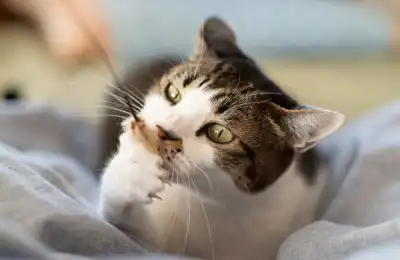
Traditional discipline, the kind you might imagine for a dog or a child, simply doesn't work on cats. Shouting, spraying water, or physically punishing a cat won't teach them what you want them to do instead. In most cases, it damages the bond of trust between you and makes your cat more anxious. A calmer, more effective approach looks like this:
- Redirect rather than react. When you catch your cat about to push something off, gently distract them with a toy or a treat placed somewhere appropriate.
- Avoid making a scene. Big reactions tend to reinforce the behaviour.
- Reward calm, desirable behaviour. If your cat walks past the coffee table without touching anything, a small treat or a warm stroke helps them learn what pleases you.
- Be consistent. Cats learn through repetition, and mixed signals confuse them.
Remember that your cat isn't being "naughty" in the way a person might be. They're responding to instinct and patterns you may have accidentally reinforced.
How to Stop Cats from Knocking Objects Over
Prevention is nearly always more effective than reaction. If you'd like to protect your belongings, take a moment to look around your home through your cat's eyes. What looks tempting, reachable, and interactive from their point of view?
- Remove or secure valuables. Put fragile items behind glass or inside closed cabinets. If something matters to you, it really shouldn't be within paw's reach.
- Use museum putty or gel. A small dab under an ornament can hold it in place without damaging the surface underneath.
- Offer acceptable alternatives. Give your cat a basket of small toys they're allowed to bat, chase, and push around to their heart's content.
- Provide vertical space. Cat trees, window perches, and wall shelves designed for cats give them somewhere appropriate to climb and survey their kingdom.
- Invest in interactive play. Daily play sessions with wand toys or puzzle feeders burn off the energy that would otherwise go straight into mischief.
How to Train a Cat Not to Knock Things Over

Training a cat takes patience, but it's entirely possible. Cats learn through association, which means you can use positive reinforcement to gently teach them what you'd like to see more of.
Start by choosing one behaviour to focus on. Perhaps it's ignoring the mug on your desk, or keeping off the kitchen counter. Whenever your cat behaves in the way you want, reward them immediately. Treats, praise in a warm voice, and gentle strokes all work beautifully. Your cat will quickly link the good behaviour with the reward.
Clicker training is another excellent tool to add to your kit. A clicker produces a consistent sound that marks the exact moment your cat did something right, followed by a small treat. With a bit of practice, many cats learn impressively complex routines this way, which also has the happy side effect of keeping their clever minds engaged.
Above all, manage your expectations kindly. Cats aren't going to stop being cats, and that's part of why we love them. You're not trying to eliminate their instincts — you're teaching them to channel those natural tendencies into behaviours that suit everyone in the household a little better.
Recommended for you!
Best Sellers







Study Feline Behaviour for £29
If this glimpse into feline psychology has left you wanting to understand your cat on a much deeper level, Centre of Excellence has a course designed with you in mind. The Feline Behaviour and Psychology Diploma Course guides you through everything from body language and communication cues to training techniques and the emotional needs of your cat. Whether you're a devoted owner hoping to build a stronger bond or someone considering a career working with cats, you'll learn from expert-led content at a pace that suits your life. For a limited time, you can enrol for the discounted price of just £29!