Egyptian mythology is one of the most fascinating and enduring in the ancient world, and the gods and goddesses at its heart shaped every aspect of life along the Nile. Whether you're new to Egyptian mythology or looking to deepen your knowledge, this guide to 12 important gods and goddesses will provide you with fascinating insights.
Jump to:
- Egyptian Gods: Names and Symbols
- Egyptian Goddesses: Names and Symbols
- Osiris: The God of the Afterlife
- Isis: The Goddess of Magic
- Horus: The Sky God
- Set: The God of Chaos
- Anubis: The God of Mummification
- Bastet: The Cat Goddess
- Thoth: The God of Wisdom
- Hathor: The Goddess of Love and Joy
- Sekhmet: The Lioness Goddess
- Ma'at: The Goddess of Truth and Justice
- Nut: The Sky Goddess
- Frequently Asked Questions about Egyptian Gods and Goddesses
Egyptian Gods: Names and Symbols
The gods of ancient Egypt were the backbone of an entire civilisation, shaping everything from how the Nile was understood to how the dead were buried. Each god carried a distinct role, a set of symbols, and a mythology that Egyptians returned to for thousands of years. Below is a summary of the key Egyptian gods, their domains, and the symbols most commonly associated with them.
| Name | Domain | Symbol |
| Ra | Sun, creation | Solar disc, falcon |
| Osiris | Afterlife, resurrection | Crook and flail |
| Isis | Magic, motherhood | Throne crown, wings |
| Anubis | Mummification, the dead | Jackal head |
| Bastet | Cats, protection, home | Cat |
| Thoth | Wisdom, writing | Ibis head |
| Horus | Sky, kingship | Falcon |
| Set | Chaos, storms | Was sceptre |
| Hathor | Love, beauty, music | Cow horns |
| Sekhmet | War, healing | Lioness head |
| Ma'at | Truth, justice | Ostrich feather |
| Nut | Sky, stars | Star-covered body |
Egyptian Goddesses: Names and Symbols
The goddesses of ancient Egypt were among the most powerful and widely worshipped figures in the entire pantheon, embodying everything from magic and motherhood to war, justice, and the night sky. Their influence stretched across every aspect of Egyptian life, from the birthing room to the afterlife. Below is a summary of the key Egyptian goddesses, their domains, and the symbols most commonly associated with them.
| Name | Domain | Symbol |
| Isis | Magic, motherhood, fertility | Throne crown, outstretched wings |
| Bastet | Cats, home, protection, fertility | Cat or woman with cat head |
| Hathor | Love, beauty, music, joy | Cow horns with sun disc |
| Sekhmet | War, destruction, healing | Lioness head |
| Ma'at | Truth, justice, cosmic order | Ostrich feather |
| Nut | Sky, stars, the cosmos | Star-covered arched body |
| Nephthys | Death, mourning, protection | Basket and house hieroglyph |
| Neith | War, weaving, hunting, wisdom | Crossed arrows and shield |
| Selket | Scorpions, healing, protection | Scorpion on head |
| Wadjet | Protection of Lower Egypt, royalty | Cobra |
| Mut | Motherhood, queenship | Double crown, vulture headdress |
| Taweret | Childbirth, fertility, protection | Pregnant hippo with lion paws |
1. Ra: The Sun God
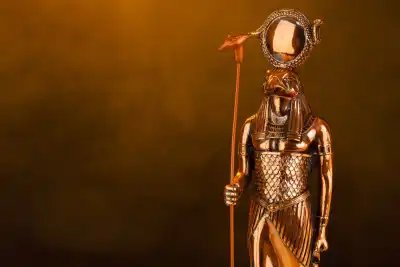
What is Ra the God of?
Ra is the god of the sun and creation, considered the most powerful deity in the Egyptian pantheon during much of ancient Egypt's history. Each day he was believed to travel across the sky in his solar barque, and each night he journeyed through the underworld, battling the serpent Apophis to ensure the sun rose again.
As the sun set, Ra entered the underworld, where he faced various challenges, including battling the serpent Apophis. This nightly journey symbolised the sun's death and rebirth, mirroring the cycle of life and death.
Ra was often depicted with a falcon head crowned with a sun disk, symbolising his dominion over the sky. Sometimes, he was shown with a scarab beetle, which represented transformation and rebirth. Ra's influence was so powerful that many pharaohs adopted the title "Son of Ra," signifying their divine right to rule.
2. Osiris: The God of the Afterlife
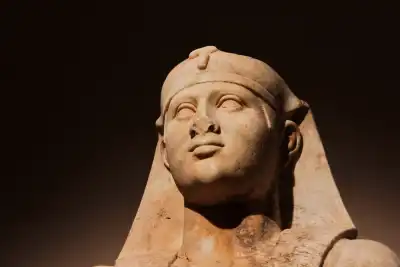
What is Osiris the god of?
Osiris, the god of the afterlife, death, and resurrection, played an important role in Egyptian mythology. He was believed to have been the first pharaoh of Egypt, and his reign was marked by peace and prosperity. However, his jealous brother Set murdered him, scattering his body parts across Egypt. Osiris's wife, Isis, collected his remains and used her magical powers to resurrect him.
Osiris was often depicted as a mummy holding a crook and flail, symbols of kingship and authority. His green skin symbolised rebirth and regeneration, highlighting his role as the god who grants eternal life. Osiris presided over the "Hall of Two Truths," where the deceased's heart was weighed against the feather of Ma'at to determine their worthiness for the afterlife.
Who are Osiris's parents?
Osiris was the son of Geb, the god of the earth, and Nut, the goddess of the sky. He was the eldest of their four children, alongside Isis, Set, and Nephthys, making him part of one of the most significant family groupings in the entire Egyptian pantheon.
What is the story of Osiris and Isis?
Osiris was the first pharaoh of Egypt, murdered by his jealous brother Set, who scattered his body across the land. His wife Isis used her powerful magic to gather his remains and resurrect him, allowing him to conceive their son Horus before Osiris descended to rule the underworld; a myth that became the foundation of Egyptian beliefs about death, resurrection, and kingship.
3. Isis: The Goddess of Magic
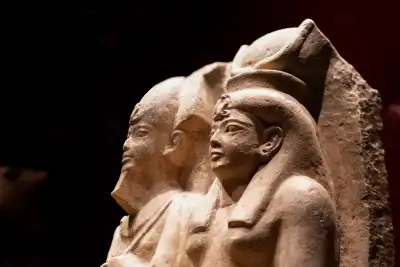
What is Isis the goddess of?
Isis was the goddess of magic, motherhood, and fertility. She was worshipped for her incredible magical abilities, which she used to protect her husband Osiris and their son Horus. Her devotion and love for her family made her one of the most beloved deities in Egyptian mythology.
Isis was depicted with a throne-shaped crown or a sun disk flanked by cow horns, symbolising her connection to royalty and the sun god Ra. She was also shown with outstretched wings, providing a protective embrace. Her magic was so powerful that she was able to resurrect Osiris and heal Horus after his battles with Set. Isis's worship spread beyond Egypt, and she became a prominent figure in the Roman Empire as well.
4. Horus: The Sky God
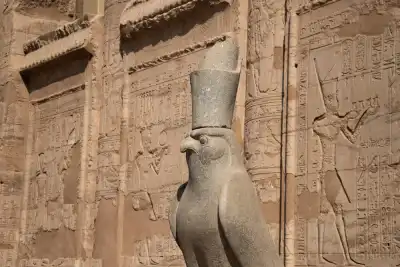
What is Horus the god of?
Horus, the son of Osiris and Isis, was the god of the sky, war, and hunting. He is often represented as a falcon or a man with a falcon head, symbolising his connection to the sky and his keen vision. Horus's eyes were said to be the sun and the moon, representing his watchful gaze over the world.
Horus avenged his father Osiris's death by defeating the god Set in a series of epic battles. This conflict symbolised the struggle between order and chaos, with Horus emerging victorious as the rightful ruler. Horus was also associated with the pharaoh, and each reigning king was considered the living embodiment of Horus. His victory over Set established him as a symbol of justice and righteous leadership.
What is the Eye of Horus?
The Eye of Horus is one of ancient Egypt's most enduring symbols, representing protection, healing, and royal power. According to myth, Horus lost his eye in battle against Set, and its restoration came to symbolise wholeness and the triumph of good over chaos — it was widely used as an amulet to ward off evil.
5. Set: The God of Chaos
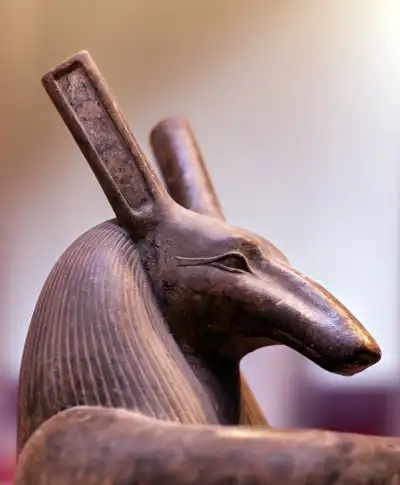
What is Set the god of?
Set, also known as Seth, was the god of chaos, storms, and the desert. He is often depicted as a mysterious creature with a canine body and a curved snout, representing his unpredictable and destructive nature. Set's association with the desert highlighted his role as a force of disorder and wilderness.
Set represented the forces of disorder and was both feared and respected by the ancient Egyptians. He murdered his brother Osiris in a bid for power, leading to a prolonged conflict with Horus. Despite his negative aspects, Set also had a protective side. He was the defender of Ra's solar barque during its nightly journey through the underworld, battling the serpent Apophis to ensure the sun's rebirth. This duality made Set a complex and multifaceted deity in Egyptian mythology.
6. Anubis: The God of Mummification
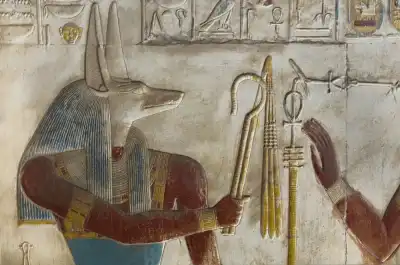
What is Anubis the god of?
Anubis is the god of mummification, death, and the afterlife. He was responsible for overseeing the embalming of the dead, guiding souls to the underworld, and presiding over the weighing of the heart ceremony that determined a soul's worthiness for eternal life.
He was depicted as a man with the head of a jackal, an animal associated with cemeteries due to its scavenging habits. Anubis's role was essential for the embalming process, as he presided over the mummification rituals that prepared the dead for the afterlife.
Anubis was closely associated with the "weighing of the heart" ceremony, a key event in the journey to the afterlife. In this ceremony, the heart of the deceased was weighed against the feather of Ma'at, the goddess of truth and justice. If the heart was lighter than the feather, the soul could enter the afterlife. Anubis's presence ensured the fairness and sanctity of this process.
Why does Anubis have a jackal head?
Anubis is depicted with a jackal head because jackals were commonly seen near cemeteries and burial sites in ancient Egypt, scavenging among the dead. The Egyptians associated this with the god of the afterlife, believing Anubis watched over the dead in a similar way, guiding and protecting rather than disturbing them.
Is Anubis the same as Hades?
Anubis and Hades are not the same, though they share some similarities as gods associated with death and the underworld. Hades rules the Greek underworld as a king and judge, while Anubis plays a more guiding and ceremonial role, presiding over mummification and the weighing of the heart rather than governing the realm of the dead outright. That role in Egyptian mythology belongs more closely to Osiris.
7. Bastet: The Cat Goddess
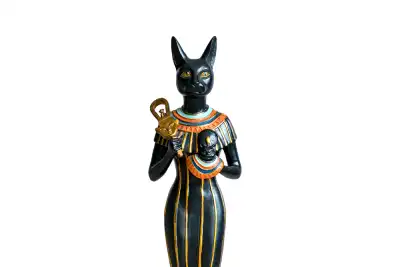
What is Bastet the goddess of?
Bastet, the goddess of home, fertility, and childbirth, was often depicted as a lioness or a woman with a lioness head in her early forms. As her worship evolved, she became associated with domestic cats, which were highly valued in ancient Egyptian households for their ability to control vermin.
Bastet was worshipped as a protector of homes and families. Her dual nature as a fierce lioness and a nurturing domestic cat symbolised her protective and caring aspects. Bastet's festivals were lively and joyous, reflecting her association with music, dance, and celebration. She was also a guardian of pregnant women and children, making her one of the most beloved deities.
8. Thoth: The God of Wisdom
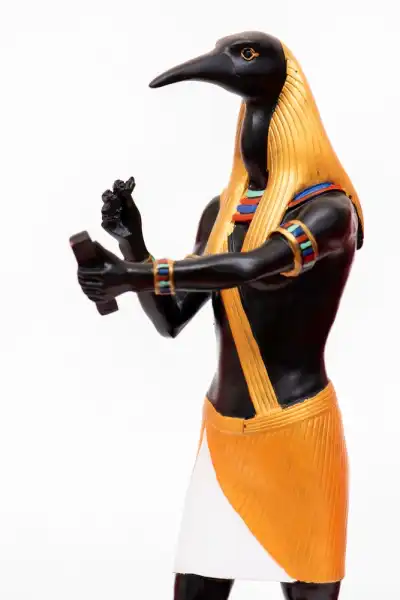
What is Thoth the god of?
Thoth was the god of wisdom, writing, and magic. Depicted as an ibis or a baboon, Thoth was believed to have invented writing and was the scribe of the gods. He recorded the results of the "weighing of the heart" ceremony, ensuring the accurate documentation of each soul's fate.
Thoth played a key role in maintaining the universe's balance and order. As the god of knowledge, he was a mediator and advisor among the gods. Thoth was also associated with the moon, which represented his role in the measurement of time and the regulation of celestial bodies. His wisdom and intellect were considered unparalleled, making him a revered figure in Egyptian mythology.
9. Hathor: The Goddess of Love and Joy
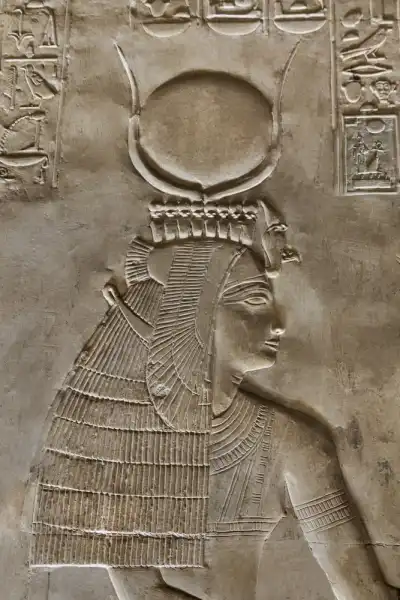
What is Hathor the goddess of?
Hathor, the goddess of love, beauty, and joy, was often depicted as a woman with cow horns and a sun disk. She was the patroness of music, dance, and fertility, embodying the positive and nurturing aspects of life. Hathor's worship included joyous festivals filled with music, dancing, and feasting.
Hathor was also known as the "Mistress of the West," welcoming the dead into the afterlife. She provided comfort and guidance to the deceased, ensuring their safe passage. Hathor's role as a motherly figure extended to her protection of women in childbirth and her association with the fertility of the land. Her nurturing nature made her one of the most beloved and widely worshipped deities.
10. Sekhmet: The Lioness Goddess
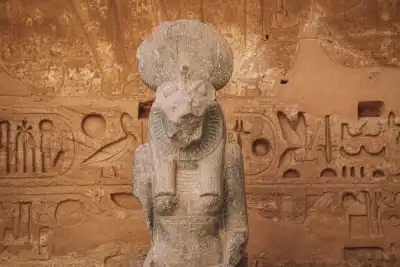
What is Sekhmet the goddess of?
Sekhmet, the goddess of war and healing, was depicted as a lioness or a woman with a lioness head. She was known for her fierce nature, embodying the destructive power of the sun.
Sekhmet was believed to breathe fire against her enemies, demonstrating her ferocity in battle.
Despite her fearsome reputation, Sekhmet also had the power to cure diseases and protect the pharaohs in battle. Her dual nature as both a destroyer and a healer highlighted the balance between chaos and order. Sekhmet's priests were skilled in medicine, and her temples served as centres for healing and medical knowledge.
11. Ma'at: The Goddess of Truth and Justice
What is Ma'at the goddess of?
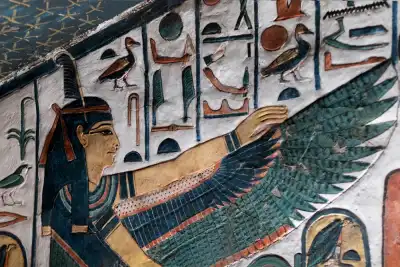
Ma'at was the goddess of truth, justice, and cosmic order. She was often depicted as a woman with an ostrich feather in her headdress, symbolising truth and balance. Ma'at's principles guided the Egyptians in their daily lives, influencing their laws, morality, and social harmony.
Ma'at's feather was used in the "weighing of the heart" ceremony, determining whether a soul was worthy of entering the afterlife. Her concept of Ma'at represented the idea that the universe operated on a delicate balance, which had to be maintained through righteous living and adherence to truth. Ma'at was essential to the functioning of both the cosmos and human society.
12. Nut: The Sky Goddess

What is Nut the goddess of?
Nut, the goddess of the sky, was depicted as a woman arched over the earth, her body adorned with stars. She swallowed the sun each evening and gave birth to it each morning, representing the cycle of night and day. Nut's protective nature extended to her role as a guardian of the heavens and the earth.
Nut was a central figure in ancient Egyptian cosmology, as she separated the chaos of the waters from the ordered world. Her daily birthing of the sun and her protective embrace over the earth symbolised the ongoing cycle of life and the nurturing aspects of the sky. Nut's imagery often included stars and celestial symbols, emphasising her connection to the cosmos.
Recommended for you!
Best Sellers

Frequently Asked Questions about Egyptian Gods and Goddesses
How many Egyptian gods are there?
There are over 2,000 deities in ancient Egyptian mythology. The exact number can vary as some gods were merged or evolved over time. The vast number reflects the rich and diverse nature of Egyptian religious practices.
Who was the most powerful Egyptian god?
Ra is often considered the most powerful Egyptian god due to his role as the sun god and the creator of life. However, other deities like Osiris and Isis also held significant power and influence in various aspects of life and the afterlife.
Who is the moon god in Egypt?
Thoth, the god of wisdom, writing, and magic, is also associated with the moon. He was believed to regulate the celestial bodies and measure time, making him an essential deity in Egyptian mythology.
Which Egyptian god is a cat?
Bastet, originally depicted as a lioness, later became associated with domestic cats. She is the cat goddess of home, fertility, and childbirth, and was worshipped as a protector of households.
Who is the Egyptian god of chaos?
Set, also known as Seth, is the god of chaos, storms, and the desert. He represents the forces of disorder and was both feared and respected by the ancient Egyptians.
Who is the Egyptian god of death?
Osiris is the god of the afterlife, death, and resurrection. He oversees the judgment of souls and their passage into the afterlife, making him a central figure in matters of death and rebirth.
Who was Anubis in love with?
In some myths, Anubis is said to be in love with Anput, a goddess associated with the protection of the dead and the mother of Kebechet, a goddess of purification.
Is there an Egyptian ice god?
While ancient Egyptian mythology doesn't prominently feature an ice god, some deities have associations with water and the elements, like Tefnut, the goddess of moisture.
Who is the Egyptian god of stars?
Nut, the sky goddess, is closely associated with the stars. Her body is often depicted adorned with stars, symbolising her connection to the night sky and the celestial bodies.
Who is the Egyptian god of war?
Horus and Sekhmet are both associated with war. Horus, as the sky god, also represents protection and kingship. Sekhmet, the lioness goddess, embodies the fierce and destructive aspects of war.
What was Cleopatra's cat's name?
While historical records don't specify the name of Cleopatra's cat, cats were highly worshipped in ancient Egypt. It's possible Cleopatra had cats as pets, given their cultural significance.
Who was the Egyptian god of infinity?
Heh is the god of eternity and infinity in Egyptian mythology. He represents endlessness and the infinite nature of the cosmos.
Who is the Egyptian god of fire?
Ra, as the sun god, is often associated with fire due to his connection with the sun. Additionally, Sekhmet, with her fierce and fiery nature, also embodies aspects of fire.
Who is the Egyptian god of terror?
Set, with his chaotic and destructive nature, could be seen as the god of terror. His role as a disruptor and his association with storms and the desert evoke fear and respect.
Who is the headless god in Egypt?
The headless god often referred to is Osiris, after being murdered by Set. Set dismembered Osiris, scattering his body parts, which Isis then reassembled and resurrected.
What is the weighing of the heart ceremony?
The weighing of the heart was a pivotal moment in the Egyptian understanding of the afterlife, in which the heart of the deceased was weighed against the feather of Ma'at, the goddess of truth and justice. If the heart was lighter than the feather, unburdened by wrongdoing, the soul was granted eternal life; if it was heavier, it was devoured by the monster Ammit, and the soul ceased to exist.
What does the ankh symbol mean?
The ankh is the ancient Egyptian symbol of life, often described as a cross with a loop at the top. It was carried by gods and pharaohs as a sign of their divine power and immortality, and is one of the most instantly recognisable symbols from the ancient world.
Study Ancient Egypt With Centre of Excellence
The gods and goddesses of ancient Egypt played an important role in the lives of the ancient Egyptians, influencing their culture, beliefs, and daily practices. If you found this exploration of Egyptian mythology intriguing, Centre of Excellence offers an Ancient Egyptian Mythology Diploma Course, which provides a deeper understanding of these fascinating deities and the magical practices associated with them. For a limited time, you can enrol in this course at a discounted price of £29, saving you over £100!